Fly Me to the Moon … Wait, Didn’t We Do That Already?

Humans first landed on the Moon 50 years ago, but some people still refuse to believe it happened. Moon hoax conspiracy theories prove that interpretation is a highly subjective practice regardless of the evidence.

By Serena Ypelaar

Can you believe we are 50 years out from the first Moon landing? That’s right: on July 20, 1969, humans set foot on the Moon for the first time in history. 

Baby boomers and their parents might remember watching the footage of the Apollo 11 mission on television, which was a critical medium for broadcasting the American feat to the entire world. The context of the Moon landing as a Cold War accomplishment, especially in the Space Race between the United States and the Soviet Union, makes the phenomenon of the Moon landing broadcast even more significant.

Those who were alive back then saw it – but not everyone believes. It may seem bizarre since the fact that humans have landed on the Moon is generally established today, but there are still people out there who think it never happened – that the entire Apollo program was a hoax, a lie fabricated by NASA using television as an aid to their deceit. 

Buzz Aldrin on the Moon, as photographed by Neil Armstrong on the Apollo 11 mission in 1969. Photo: Wikipedia

How can a conspiracy theory (or theories, as there are many variations of the argument that the Moon landing didn’t actually happen) survive for 50 years, seemingly in defiance of logic?

I’ve been thinking about it, and I think it comes down to the way evidence is interpreted. Any given piece of evidence – whether it be presented visually, aurally or otherwise – can either be accepted as part of a coherent narrative or rejected as incredible. Conspiracy theories come from those who refuse to accept the mainstream narrative, in this case that the first Moon landing happened on July 20, 1969, because they question the veracity of the evidence. 

People are still fascinated by the footage of the Moon landing, from preparation to takeoff to landing. CNN has been airing the documentary Apollo 11, directed by Todd Douglas Miller and featuring “rare and never-before-seen large-format film footage”. The film itself is also an interpretation of the event, since creating it involved selecting and editing clips to tell the story in a way that is understandable for mass consumption. And yet, the compendium of Moon landing footage out there is not convincing enough for conspiracists, who claim it’s part of a massive hoax. 
From the assertion that NASA roped in Stanley Kubrick to direct film footage of a faked Moon landing to the belief that up to 400,000 personnel helped develop and release the alleged false narrative over 10 years, all of the conspiracy theories are wildly imaginative and also cannot possibly coexist, therefore undermining the credibility of each one. 

The nature of conspiracy theories is to interpret pieces of tangible evidence or content through a specific lens or argument, which could be motivated by confirmation bias or another fallacy of logic that involves distorting or discrediting evidence to make it suit an alternative story. In the case of the Moon landing hoax conspiracies, people assert that evidence of the Moon landings, most notably footage, is faulty, and because it is (in their opinion) faulty, it must be fabricated. 

There’s an entire list of supposed issues with NASA’s Moon landing, issues which have been cited in conspiracies but have since been refuted by scientists. But if pointing out flaws in the footage was the main ammunition of the conspiracists, do they then suggest that reality must be perfect and errors indicate fabrication? The logical reasoning is hard to follow, and yet conspiracists are inclined to occupy their minds with a kind of subversive interpretive technique in order to pursue the established history. 

Still from “Le Voyage Dans La Lune” / “A Trip to the Moon”, the 1902 film by Georges Méliès that fascinated the world. Photo: Wikipedia

What does this mean in the greater scheme of history and conspiracy theories? I’d bet money they will continue to thrive as long as there’s someone to tout them and someone else to buy in. And by all means, it’s important and valuable to question the prevalent perspectives of history and who preserves those narratives in the first place. But at the heart of conspiracy theory is a delight, I think, in observing that which others have not observed, and believing in a secret truth that others can’t hope to access unless they join in and enter this underground interpretative world.

As for me, I think I’d rather just enjoy the beauty and majesty of the Moon – at a comfortable distance. 

.

Looking for a concept album to celebrate the Moon landing? Try “Tranquility Base Hotel + Casino” by Arctic Monkeys – a record about a hotel on the Moon.
Interpreting the Zapruder film

55 years after the assassination of U.S. President John F. Kennedy, we still have much to learn about the famous Zapruder film, which captured the incident in Dallas.

Warning: contains mention/images of graphic violence and may be disturbing for some readers.

By Serena Ypelaar

November 22, 1963. John F. Kennedy greets the public in the presidential motorcade as he heads toward Dealey Plaza and the Texas School Book Depository. As the car turns off of Elm Street, onlookers gathered along the side of the road cheer, clap, and wave to the President and his wife, Jacqueline.

The next few seconds would drastically change the future – and believe it or not, they were caught on film.

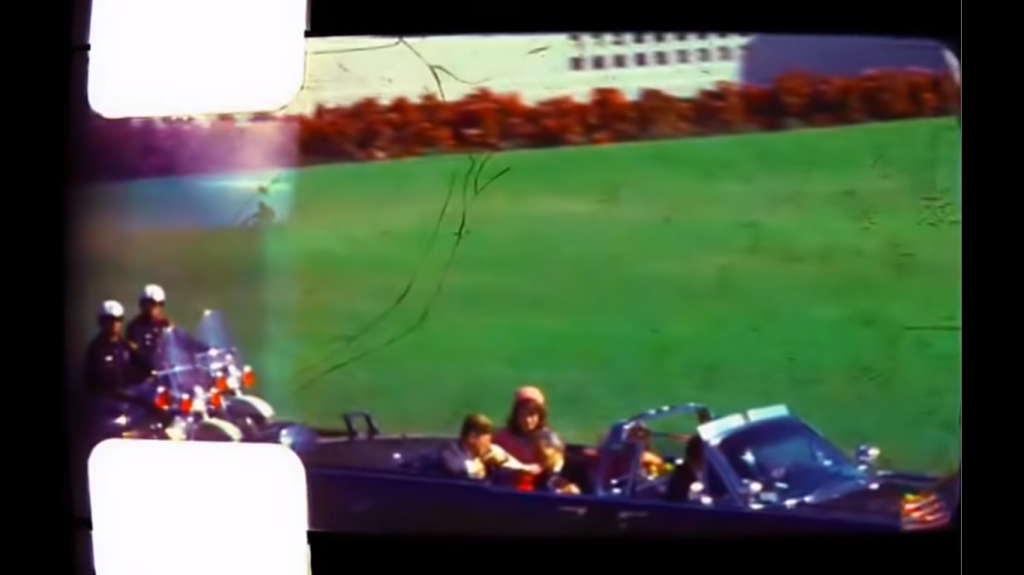
The Zapruder film (graphic content) preserves those moments when JFK was fatally shot, and it’s hence been scrutinized closely for decades. Abraham Zapruder was an ordinary U.S. citizen who happened to be in the right place at the right time, unknowingly documenting a tragic event that would go down in history.

zapruder2
Screencap taken from the Zapruder film.

You might think there’s nothing of value to gain from watching the murder of a political leader, but in this context that couldn’t be further from the truth. Zapruder wasn’t to know that the U.S. government would seize his short film when the Warren Commission was launched to investigate the assassination – he was merely recording the event for himself, on a Bell & Howell home movie camera.

There are others who filmed the assassination, but I want to focus on Zapruder’s close-range footage for its interpretive value.

zaprudercam
Abraham Zapruder’s camera, which is now held in the U.S. National Archives. Photo: Wikimedia Commons

I mentioned that viewing the murder was crucial rather than gratuitous – and now I’ll explain why. JFK’s suspected killer, Lee Harvey Oswald, was shot dead by nightclub owner Jack Ruby before he could be extensively questioned or tried for the murder. This turn of events spawned boundless conspiracy theories, including ones in which Oswald was not the shooter, or that government(s) or other third parties were behind the assassination.

Oswald is alleged to have fired the shots from the sixth floor of the Texas School Book Depository. His own whereabouts and location have been intensely analyzed in order to place him at the scene of the crime: the source of the gunshots. To find and prove the source, the Zapruder film is an invaluable piece of evidence.

jfkoswald
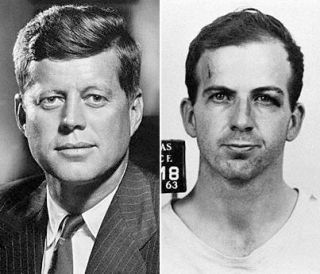
President John F. Kennedy and Lee Harvey Oswald. Source: Psychology Today

Analysts and scientists have hypothesized on the trajectory of the bullets entering and exiting President Kennedy’s body. While many have opposing views on their path and therefore their source location, the point is that without Zapruder’s film, the investigation would have relied instead on subjective witness testimony.

However, discrepancies were perceived between witness testimony and the film’s contents. In an editorial for the New York Times in 2007, Max Holland and Johann Rush assert that Zapruder’s film was initially misunderstood because it seemed to show only two of the three shots believed to have been fired:

The majority of witnesses in Dealey Plaza heard three shots fired. Lawmen found three cartridges in Lee Harvey Oswald’s nest … Yet Zapruder’s film captured only two shots clearly. As a result, the film has been scoured for evidence of another shot, presumably the first one fired at the president. Research has yielded contradictory findings.

But what if Zapruder simply hadn’t turned on his camera in time?

Holland and Rush state that Zapruder commenced filming but turned off his camera when waiting for the President’s limousine to come into view. They suggest that he didn’t turn it back on again until after Oswald had fired his first shot. Viewing the film as incomplete therefore answers a question that loomed large over the Warren Commission investigation: why did Oswald miss the closest shot but prove such an accurate sniper in the two shots following (at 190 and 265 ft. respectively)?

“About the time the car got near the black and white sign, I heard a shot,” a key witness, Amos L. Euins, had said. Holland and Rush argue that it was the sign itself that blocked Oswald’s view of Kennedy. Sure enough, in watching the Zapruder film we lack the first shot but see the next two – after the President passes near a large sign. Startlingly, of the three shots fired, Zapruder managed to document the two that found their target.

The film, we realize, does not depict an assassination about to commence. It shows one that had already started.

The Zapruder film is central to the historical record of Kennedy’s assassination, as is careful analysis. The angles from which one can interpret the film prove that despite its overwhelming value to those trying to understand the event, it provides only a limited (though crucially significant) slice of what happened that day, contingent on a man’s choices of when to record … and his inability to know what was about to happen.