I recently had the chance to see the “Impressionist Treasures” exhibition at the National Gallery of Canada, and while the big names of impressionism were impressive, it was a lesser known painter of the Danish Golden Age who really caught my eye. I had never heard of Vilhelm Hammershøi or seen his work before, but after Cezanne’s airy landscapes and Gauguin’s striking primary colours, Hammershøi’s dark, muted interiors were a startling change of pace.
Vilhelm Hammershøi, Interior with Piano and Woman in Black. From the Artist’s Home at Strandgade 30 (1901). Photo: National Gallery of Canada
Hammershøi’s subjects were mundane and simple, but painted in such a way that made them seem cold and distant and mysterious. In his time, he was known as “the painter of tranquil rooms.” And they are tranquil, yes. But it seems to me that beneath the tranquility lies something a little darker, a little more unsettling. The rooms he painted are almost always empty. When a figure does occupy them—usually Hammershøi’s wife, Ida—her back is turned away from us, or else her face blurred, indistinct. Hammershøi’s paintings seem devoid of life, yet they remain evocative and alluring. Standing there in the gallery, gazing into a space that looked less than inviting, whatever tranquility I might have felt began to transform into something else.
The word that comes to mind is uncanny. Hammershøi takes the utterly familiar—his home, his wife—and makes them seem strange and disquieting—unfamiliar. Now, forgive me for invoking Freud, but he was onto something when he talked about the uncanny. According to Freud, “the uncanny is that class of the frightening which leads back to what is known of old and long familiar.” It’s the experience of discovering the familiar in what is strange and unknown. Think the uncanny valley—the closer a thing is to human likeness without actually being human, the creepier it seems to us. The same concept applies here. Hammershøi’s interiors are nothing if not uncanny. The longer you stare into his dim hallways and lifeless living rooms, the more unsettling they become.
Take, for instance, my favourite painting featured in the exhibition, The Four Rooms:
Vilhelm Hammershøi, Interior. “The Four Rooms” (1914). Photo: Wikimedia Commons
At first glance, it seems innocuous. But there’s something just a little bit off about this painting. Doors hang open at different angles. Floorboards don’t quite line up. Lines are disrupted everywhere and there doesn’t appear to be a way out. It almost looks like when you hold up a mirror to another mirror, creating an endless reflection of frames. Rooms lead into rooms which ultimately lead nowhere.
It’s no coincidence that Hammershøi painted The Four Rooms in 1914, the year World War I began. People often think of the early twentieth century, and particularly the interwar period, as an Age of Uncertainty. But perhaps a better name might be the Age of the Uncanny. The Great War threw everyday life off-balance and what was once familiar became, well, unfamiliar. Like a house that is no longer a home. In this case, one we’re compelled to return to again and again because it unsettles us in all the right ways.
The autobiography is a curious means of presenting one’s life story, one that allows for filtration and condensation into a story as engaging as the author (the self-biographer) desires.
Lately, I’ve been thinking a lot about autobiographies, in which someone illustrates their own life by selectively exploring episodes of their past. There’s a certain kind of autonomy in fashioning one’s own life story for public consumption, in which we can filter out certain aspects like a sieve. Maybe we don’t want unflattering elements of our lives to reach the eyes and ears of others – but would that be as compelling a story?
If we don’t admit our failures, conflict, setbacks, surprises, embarrassments, and other negative experiences, what shadow of ourselves are we presenting? The phenomenon of “self-fashioning” is all the more relevant to us in the twenty-first century, since Instagram and other social media rule the day. Our Instagram pages are curated galleries of our identity, but they’re only the tip of the iceberg, an infinitesimal slice of our actual lives. They nevertheless create an impression that lasts, especially when we don’t often see someone in person. Short of communicating with them directly, we’re left with what they present to us on social media, a public front that one can’t call balanced. This controlled presentation is like a darkened room that only allows light through tiny cracks – the cracks being the posts we decide to share.
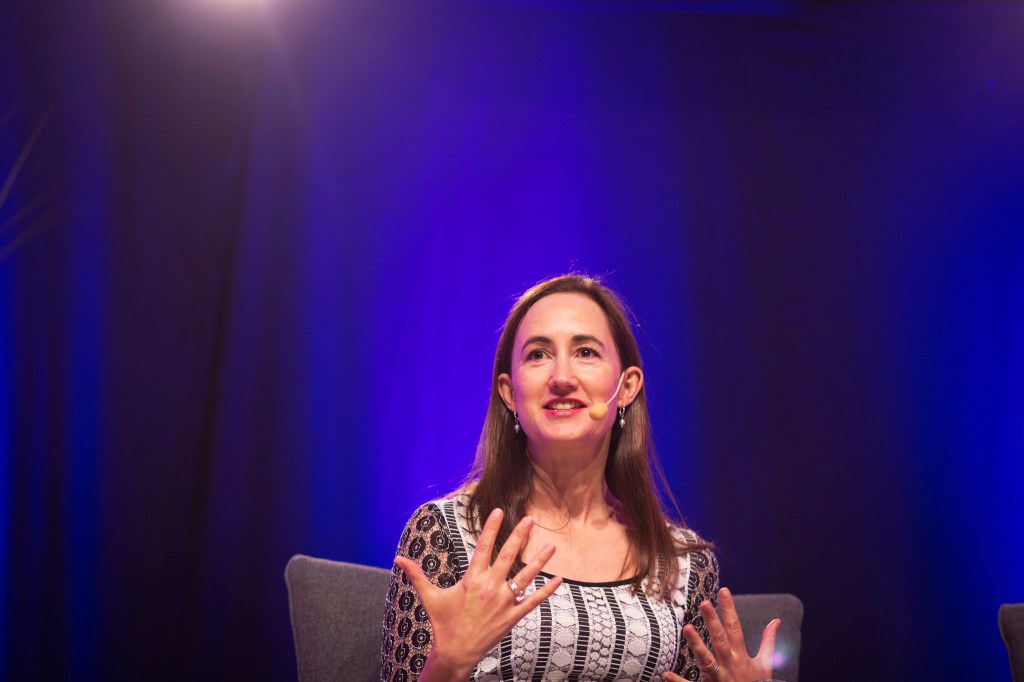
Author Sophie Kinsella writes authentic protagonists who own their mistakes and suffer embarrassing moments like all of us. Photo: Niklas Maupoix
British novelist Sophie Kinsella recently released a book titled My Not So Perfect Life (2017) which focused on the warped perceptions of our lives and others’ thanks to social media. Kinsella has encouraged readers to share less-than-perfect moments of their lives on Instagram and to celebrate them as a typical facet of the human experience. But the persistent insincerity of Instagram mirrors the ability of formal autobiographies to stretch, filter, and warp the truth. When publishing on social media, we’re sharing only the parts of ourselves that we want the world to see.
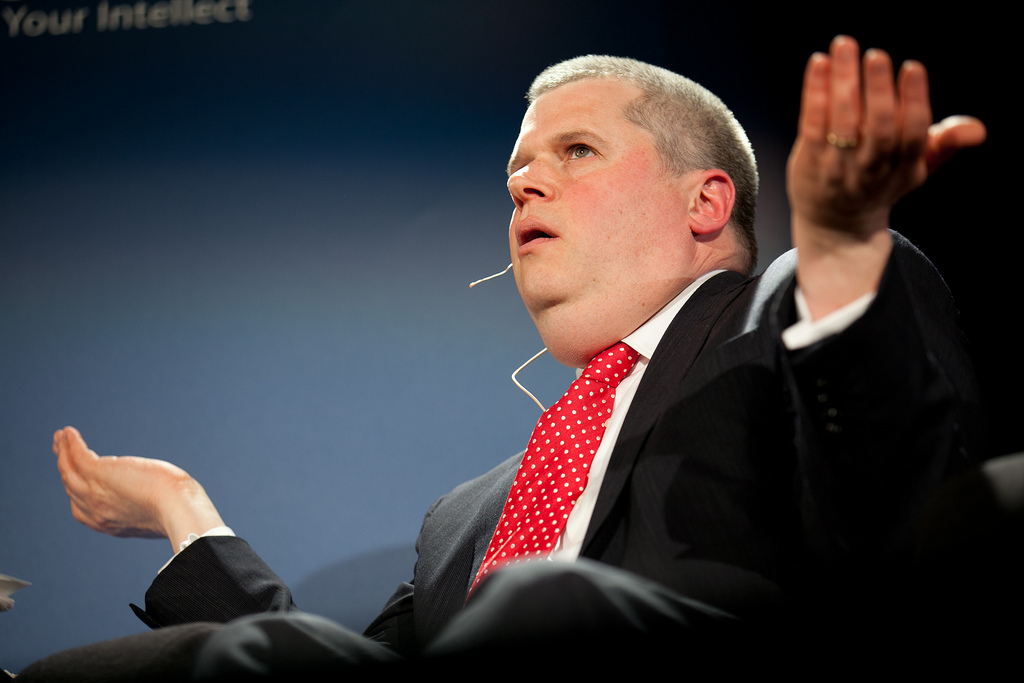
Lemony Snicket provides another, albeit exaggerated view into self-fashioning: his Unauthorized Autobiography (2002) is a dramatized example of how the autobiography is a tool of self-invention. Lemony Snicket is in fact a fictitious character (created by American author Daniel Handler) credited with chronicling the lives of the also fictional Baudelaire orphans. Likewise, Snicket’s autobiography represents the lengths that we can go to in order to construct and manipulate identity on a public platform.
Author Daniel Handler, who also writes under the pseudonym “Lemony Snicket”, created the Unauthorized Autobiography to compile selected information about his fictitious alter ego. Photo: JD Lasica
Whether or not we’re actually writing a formal autobiography, we are authoring our identity every day, inventing our public face based on how we act and what we share. When documenting that identity, we can and should carry an awareness of how we will be perceived by others not only today, but in the future. In the practice of history, for instance, we try to understand people who have predeceased us based on records left behind; it’ll henceforth be interesting to see how historical analysis proceeds in the digital age.
The true self, the one we are when we are alone, only has one audience member: ourselves. Our true identity is beyond communicating with others because there are so many layers to such an identity; so we’re burdened with the responsibility of choosing how we present it to the world. The question is, will we favour authenticity or will we compete on the basis of concealing our very human flaws?
Ah, fanfiction. Constantly derided, gleefully parodied, snidely dismissed. Even some creators are opposed to it (most famously Anne Rice, but also George R.R. Martin and Diana Gabaldon), preferring that fans refrain from writing fanfiction of their works.
Tina Belcher, a teenage girl, shows us how it’s done in Bob’s Burgers. Photo: Know Your Meme.
I could argue about how sneering over fanfic tends to have a misogynist bent, as fanfic is generally seen as the realm of teenage girls. I could also point out that this dismissive attitude has tinges of homophobia, as most fanfiction is characterized as “slash fiction” (sexual relationships between same-sex characters generally not explored in the original canon), which is accordingly chided as ridiculous. However, in this post, I will stick to examining examples of fanfic produced by well-known creators, who seem to escape the stigma by virtue of being established authors. These authors nonetheless create fanfiction for the same reasons that ordinary teenagers do: to explore the unexplored, and to express love for the source material.
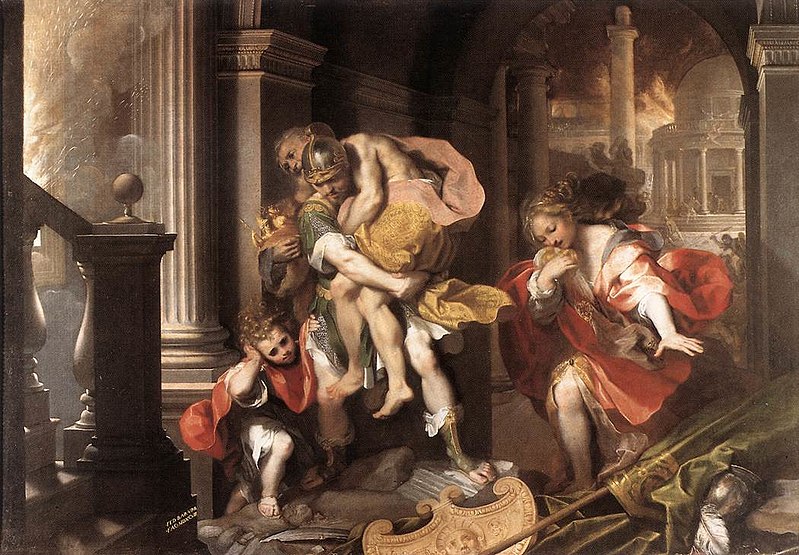
Fanfiction has existed for a long time. Virgil’s Aeneid is arguably fanfic of the Iliad, and is an example of a work that explores the unexplored, showing the other side of the Trojan War from the perspective of Trojan warrior Aeneas.
Like The Iliad, The Aeneid itself has spawned its own iconic imagery, such as this 1598 painting by Frederico Barocci showing the flight of Aeneas and his family from Troy. Photo: Wikimedia Commons.
Pastiches often examine hidden perspectives and bring them to the forefront, frequently casting the original works in a new light. The Penelopiad by Margaret Atwood puts a twist on the Odyssey by exploring the perspectives of Penelope and her twelve maids. Jean Rhys’ Wide Sargasso Sea acts as a prequel to Jane Eyre, telling the story behind Mr. Rochester’s doomed first marriage and giving Bertha much-needed sympathy and humanity. Wicked by Gregory Maguire retells The Wizard of Oz from the viewpoint of the villainous Wicked Witch of the West, explaining the reasoning behind her decisions. Geraldine Brooks’ Little Women fanfiction March places much emphasis on slavery, an institution that defined the social and physical landscape of mid-19th century America but is left unspoken in Little Women. These examples show that beloved stories are still capable of revealing new discoveries.
A Study in Emerald was later adapted into a comic book. Photo: Dark Horse Comics.
Not all fanfictions make changes to their source material, and there are many that seem to have been created for the sheer pleasure of engaging with a beloved work. Sherlock Holmes pastiches have existed since Arthur Conan Doyle’s days (and he cared little about what these creators did with his intellectual property). Even established novelists have participated in the Holmesian fun. Neil Gaiman’s “A Study in Emerald” is actually a fanfiction of TWO works, H.P. Lovecraft’s universe and Sherlock Holmes, and serves as a love letter to both.
The persistence of Holmesian fandom, still active nearly a century after Doyle’s last Holmes story was published, shows how much audiences love Sherlock Holmes. We want to continue to have adventures with him, even if that means making our own adventures.
If professional authors can write fanfiction to great acclaim, why do we deride teenagers, just learning how to stretch their literary muscles, for doing the same? Seasoned authors have played in other creators’ sandboxes. Let emerging writers do the same.
One thing we can’t glean from history prior to the invention of the phonograph is how people’s voices sounded. We may feel a profound connection with historical figures but can never hear how they spoke, a key aspect of their identity and personality.
Historical figures are more than just pictures on a page. They are people who lived and contributed to their communities, and trying to imagine them doing so can be a challenge to historians depending on what evidence remains. We’re always searching for more insight into the key quality that truly brings a historical figures to life: their personality.
Just as we once had no photographs to see what people really looked like, so too did we once lack film evidence that people really lived and spoke in distinctive ways. In trying to get a sense of mannerisms and voice, we first had to rely on audio.
Why do I think voice is such an important aspect of connecting to those who have predeceased us? I’m going to use politicians as my prime example. Many politicians are remembered as great orators whose speeches have moved and influenced societies during major events, from celebrations to declarations of war. I believe our voices carry much emotion, therefore conveying an important aspect of who we are.
Martin Luther King Jr. addressing crowds in Washington, DC. Photo: National Park Service
Think about it: how many times have you seen/met someone, and at first glance expected them to have a specific kind of voice (low, high, quavery, strong, accented)? And then they open their mouths and a completely different voice comes out! It changes your impression of them, doesn’t it? For instance, Daniel Day Lewis speaks in a higher pitch in the film Lincoln (2012), illustrating the surprising truth about former American President Abraham Lincoln’s high, reedy voice. It just goes to show how much the quality of one’s voice defines their presence.
Voices can be commanding or meek; soft or loud; rough or smooth; and all these sensory elements shape and cement identity, especially in public memory.
Take King George VI of Great Britain, and his speech of 3 September 1939 in which he confirms Britain’s involvement in World War II. This is the very same speech featured in the 2010 film The King’s Speech, as played by Colin Firth – and we can gain such a significant connection when hearing the King’s voice that it’s as if he’s in the room with us (such was the initial reaction to radio). If you listen to the real speech, you can hear George VI’s inflection and get a better impression of his presence, breaking an interpretation barrier that keeps him (and likewise, other historical figures) at a distance from us today.
Would Martin Luther King Jr.’s “I Have A Dream” speech (28 August 1963) be as rousing if we had read it on paper? Dr. King’s delivery of the speech is often remembered as an iconic capstone of the Civil Rights Movement, demonstrating the significance of voice and audio in preserving historical records. Similarly, former British Prime Minister Sir Winston Churchill’s characteristic drone is recognizable to many of us, and his famous WWII “We Shall Fight on the Beaches” speech (4 June 1940) has also been recreated in recent films such as Dunkirk (2017) and Darkest Hour (2017).
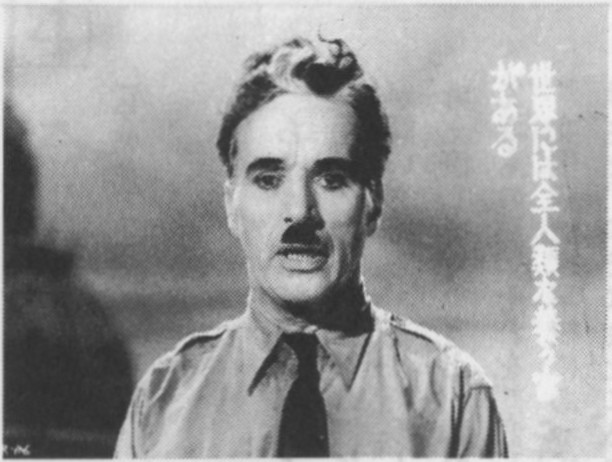
Charlie Chaplin, a British actor who was primarily known for his silent films, also understood the power of speech and voice in captivating and inspiring audiences. Taking advantage of the emergence of sound in film, his speech in The Great Dictator (1940) subverts Adolf Hitler’s acknowledged oratory skills and uses them for good in his own parody version of a wartime dictator’s speech.
Charlie Chaplin in The Great Dictator (1940). Photo: Wikimedia Commons
Still further, accents offer a whole different opportunity for biographical interpretation: for example, though former Canadian Prime Minister Sir Wilfrid Laurier was a Quebecois francophone, he learned English in New Glasgow and therefore spoke with a slight Scottish accent, something I could never learn from merely looking at photographs or silent film clips. Observations were written down, but without audio we can never hear them for ourselves. The first Canadian Prime Minister Sir John A. Macdonald’s accent is also in question, as he was raised in the Bay of Quinte/Kingston, Ontario, far from Glasgow itself (though the latter was his birthplace). American President John F. Kennedy’s Boston accent also defines his aura in our memories. If we can hear politicians speak, we can further understand their essence as people and their leadership qualities.
Is this post, then, a prolonged lamentation that I’ll never get to hear the voices of so many historical figures who captivate me? I’m not denying it – and I’m arguing that we could all do with taking some time away from our highly absorbing smartphones to be present. Listen to people’s voices, enjoy the timbre and cadence, connect with the emotions that shine through when people speak. We often take it for granted that we’ll get to hear their voices every day, but when they’re gone, all that will be left of them is our memory and the records we’ve kept.
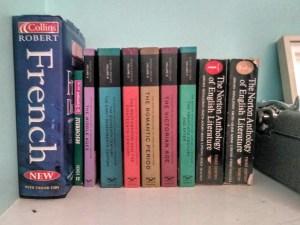
As literary scholars, book lovers, and participants in popular culture, we are conditioned to become “well-read”. But what weight does the established canon really hold? What is the reward for pursuing literature that is widely lauded as a “great book”?
The author’s copies of the Norton Anthology of English Literature, which is naught but a particularly large List of Great Books. Photo: Jennifer Lee.
The arguments against the Western literary canon are well-rehearsed. The Canon is dominated by the Dead White Male, with a smattering of token female authors, authors of colour, authors with disabilities. It’s a gatekeeper: people who aren’t familiar with the Canon are excluded from our cultural conversations, because they don’t really know about books. It trains us to extend endless sympathy to angry white men and none at all to … anyone else.
The Canon is the guy at the party who won’t stop talking about Dude Books, but has never read Pride and Prejudice (and yet has an argument about why it’s not a great literary work). The Canon makes you read everything he thought was good when he was fourteen, but leaves every book you lend him on his bedside table, untouched. Every time you struggle through one of his Dude Books, two more appear, like the heads of the Hydra. Admittedly, sometimes they’re good, but they’re not Zadie Smith good.
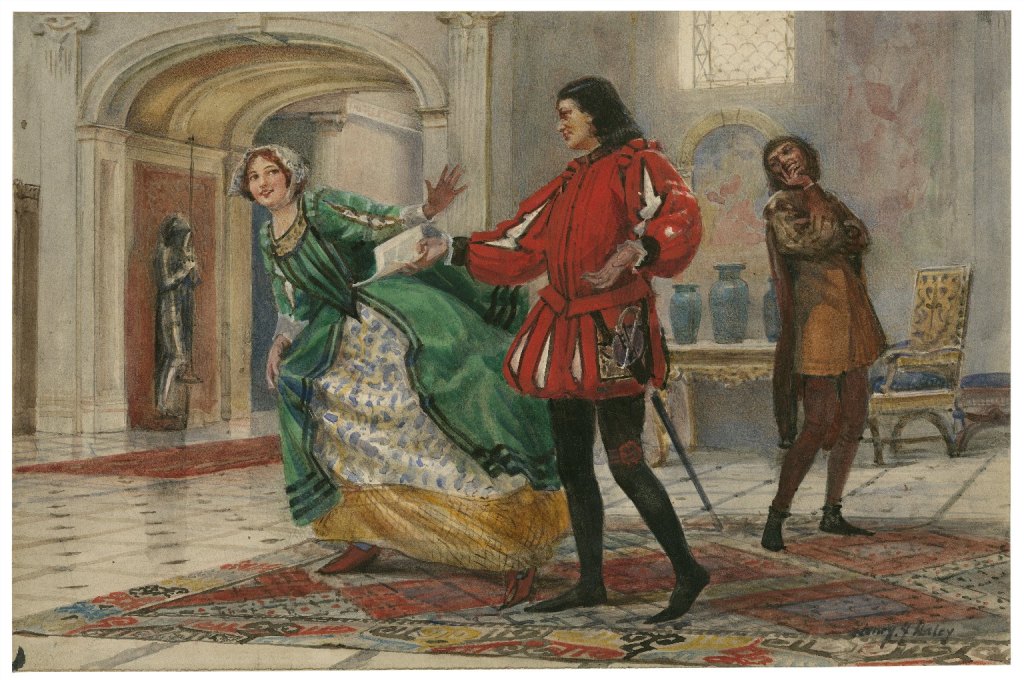
Oh! It’s another book! That you want me to read! Thanks, I’m actually allergic to Salinger, it’s the weirdest thing, I get hives. Huge bummer but what can you do? Source: Wikimedia Commons.
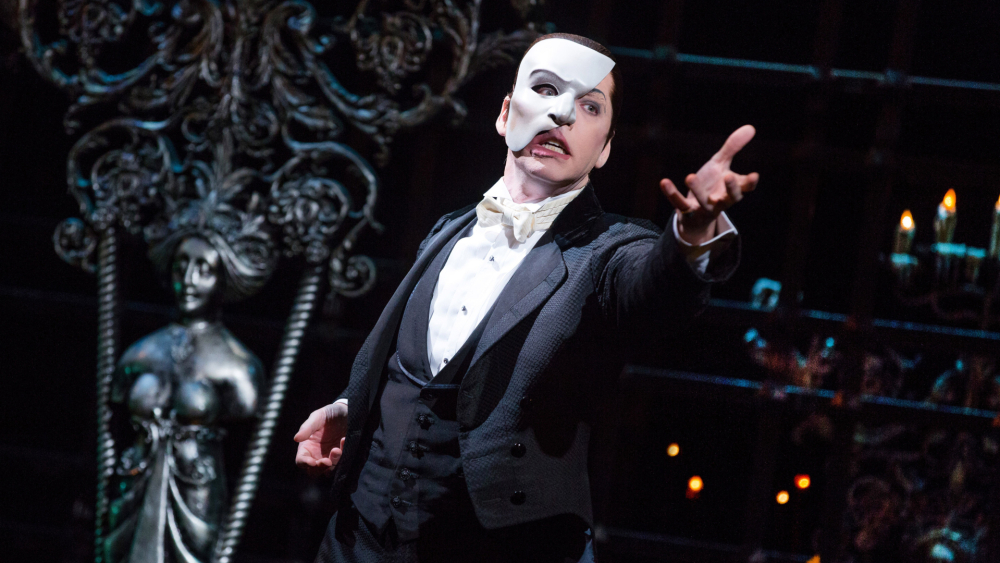
The Canon is inside my head, like the Phantom of the Opera, if the Phantom of the Opera did not offer singing advice but instead just exhorted you to read Dostoyevsky.
The Canon is a bad boyfriend, so why is it so hard to break up with it?
“CHRISTINE! Did you finish Atlas Shrugged yet? I know it’s 1200 pages long, but it only took me four days once I got into it. I just feel like Rand was really prescient.” Photo: Matthew Murphy.
I know, intellectually, that these Lists are restrictive, limiting the stories we read and talk about and write, that they arise from power structures I don’t want to uphold. But letting go of the Great Books is more frightening than liberating. If I admit that I think Restoration drama is uniformly terrible* and will never like Wordsworth, then who will present me with a great big trophy and universal approbation for finally being a Well-Read Individual?
There are the stories in the Canon, and then there’s the story of the Canon: the lie that running on the hamster wheel of European thought makes you some kind of literary Ubermensch, that there is only one way to cultural competence and only one culture worth being competent in.
It turns out you can just BUY THESE on the internet and no one even makes you take a quiz. Photo: Paper Pastries.
I know this, and yet a set of leatherbound classics still makes my pupils dilate in a Pavlovian reaction. There is no prize for being ‘well-read’, but so much of my early formation, as a reader, a critic, a person, was staked on the premise that there might be.
Is it enough to see the Canon for the arbitrary racket it is, to choose instead the company of authors I love, who speak to me? To catch myself before I ask someone else, with reflexive incredulity, “You haven’t read any Auden?” Or do I need to delete the Canon’s number from my phone and start again, building my own Great Books from scratch? Can I finally ghost on The Faerie Queene?
Historical advisors make sure the era-specific details of television and film are portrayed authentically. Using Downton Abbey as a case study, we examine the various aspects they consider when recreating a time period.
The approach of fall, and later winter, inevitably means one thing: More time indoors = more television = more period dramas.
In mainstream media, historical television has gained traction in recent years, with shows like Downton Abbey, Peaky Blinders, Poldark, Mad Men, and The Crown gaining cult followings. As a historian, I love a good period drama, since watching a fictional recreation of an era is one of the best ways to learn about it. Of course, being a historian means I’m also hung up on accuracy.
Did you know there’s a specific job in which people ensure period dramas are accurate? Those magical people are called historical advisors.
Not every show has one, but I’d like to argue the importance of such a role. In the most miniscule ways, historical dramas give viewers a vivid impression of life in a specific era. The details simply provide a backdrop for the overarching narrative, but if incorrect, they undermine the story and realism of the series. I’ve highlighted five key elements a historical advisor must oversee to help interpret history for television and produce a credible period drama. In the interest of time, all examples come from Downton Abbey, whose historical advisor Alastair Bruce has spoken publicly about his role.
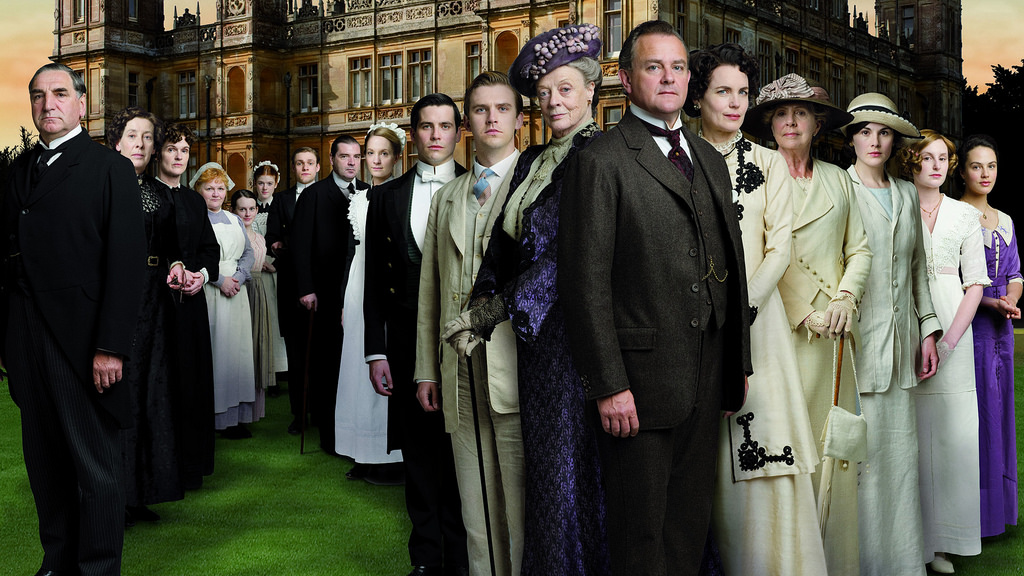
Ensemble cast of Downton Abbey, in Season 1 promotional image. From left: Jim Carter, Phyllis Logan, Siobhan Finneran, Lesley Nicol, Sophie McShera, Rose Leslie, Thomas Howes, Brendan Coyle, Joanne Froggatt, Rob James-Collier, Dan Stevens, Dame Maggie Smith, Hugh Bonneville, Elizabeth McGovern, Penelope Wilton, Michelle Dockery, Laura Carmichael, Jessica Brown Findlay. Photo: Flickr
Setting, set design, and technology
Set in Edwardian England, Downton Abbey follows the aristocratic Crawley family and their servants in the eponymous great house. We’re treated with an (albeit rose-tinted) illustration of British society and its evolution from 1912 through 1926. It’s important that these shows capture setting in a way that transports viewers while avoiding anachronisms. Sets must be dressed with care, including items such as telephones, musical instruments, and furniture to highlight technological advances of the time.
Costuming, dress codes, and wardrobe etiquette
Downton Abbey capitalizes on portraying everyday aspects of life, such as dining or dressing, seen here. Source: Golden Globes
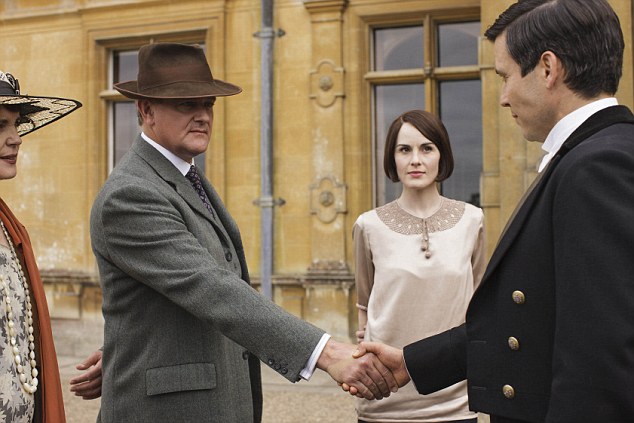
Perhaps the most universally enjoyed element of historical drama is the fashion. Historical advisors should ideally work with costume designers for accuracy, since clothing leaves a lasting overall impression. In an upstairs-downstairs series like Downton, the frequent act of the staff dressing their employers demonstrates how garments were worn. Alastair Bruce famously intervened in a scene in which newspaper man Sir Richard Carlisle shakes hands with Cora Crawley with his glove on. According to Bruce, gentlemen would always remove a glove before shaking hands.
Mannerisms, accents, and speech
Downton Abbey is located in Yorkshire, but you won’t hear the upper-crust Crawleys speaking with northern accents. Actress Michelle Dockery, who normally speaks with an Essex accent, had to adopt a measured drawl to convincingly play the aloof Lady Mary. Conversely, you’ll find the belowstairs staff using coarser dialects. Historical advisors must ensure consistency as well as monitor word choice in scripts, as some words weren’t commonly used yet. Physical mannerisms likewise illustrate character; the Crawleys and their peers would walk rigidly upright while the working class characters have a different gait, especially when relaxing “off-duty”. These details may seem insignificant to viewers, but when employed they can help teach us the nuances of how our forebears lived.
Downton Abbey’s historical advisor, Alastair Bruce. Source: Downton Abbey Wiki
Gender, race, sexual orientation, and class politics
Often, dynamics between people from different stations in life drive the tension in period dramas. Any good period drama will highlight change, usually in the form of innovation, social causes, and cultural shifts. It’s essential that historical advisors allow writers to capitalize on these changes without sacrificing legitimacy. In a series like Downton Abbey, where men and women of varying status and motivations interact in a large house, there are specific protocols which historically would have been followed – and which Alastair Bruce had to emphasize during filming.
Society, nationalism, trends, and overarching historical context
The wider historical backdrop is the linchpin. It shapes the characters’ outlook, values, and knowledge (How do they understand the world? What has happened at this point, and what is yet to come? Are they racist? Probably). National context, such as British sentiment during World War I, was crucial to understand while writing Downton. This is one area I feel Bruce and writer Julian Fellowes falter – not in the overall context, but in the mindsets of their characters. The Crawleys are astonishingly progressive for conservative landowners; certain characters exhibit a surprising lack of prejudice, which at times breaks the carefully crafted personas from their vantage point of a hundred years ago. Nevertheless, the motivation was undoubtedly to foster empathy, which in a television series is understandable.
So we’re supposed to believe that these wealthy conservative Britons living a hundred years before us have the same tolerant sensibilities of our time? Oooookay (but we love the outfits so we’ll suspend our disbelief, am I right?) Source: The Daily Mail
With prior knowledge of Fellowes’ planned storylines before each season, Bruce conducted preliminary research using specific case studies – in this case, country houses in England – to determine the aspects of life in a country estate like the fictional Downton Abbey. He then advised on the finer elements of the story’s execution.
As someone who writes historical fiction, I can relate. I’ve always found the storyline to be the core of a project – the steering wheel, so to speak – while the research, the actual historical facts, are the engine. The creator is the driver. In period television, the writer and historical advisor must copilot the vehicle if they are to arrive smoothly at their destination: a polished, realistic period drama that will appeal to laymen and historians alike.* Granted, Downton Abbey is certainly not without its critics (myself included when it comes to the later seasons), but the showrunners’ meticulous attention to detail does it credit.
*Fans of Downton Abbey will hopefully forgive me for my tactless use of a car metaphor – it just came to me as I went. Trust me, I know it’s a sore spot, as I myself haven’t quite gotten over The Incident from the 2012 Christmas special…
Period dramas often fudge the accuracy of historical costumes, resulting in possible misconceptions and a flawed feel. But what happens when a series puts the work into capturing period-specific attire?
Let’s talk about a trope I am resentfully fascinated by: inaccurate fashion in historical films. Many such films reflect the standards of attractiveness at the time they were made, often at the expense of historical accuracy.
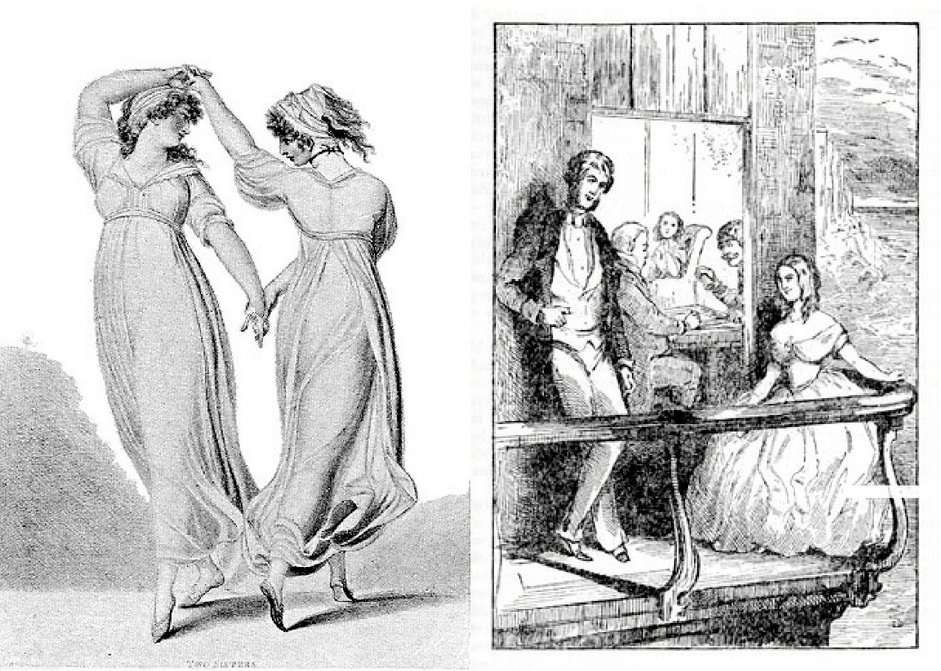
On the left, apparently “hideous” costumes, and on the right, one of Thackeray’s… improvements. Photo Credit: Left, Sisters Dancing, Marino Bovi; right, A Family Party at Brighton,William Thackeray, scanned by Gerald Ajam.
Let’s start off our look at film examples with Disney. Snow White (1937) has a tidily-curled bob; the accentuated waists of Cinderella’s (1950) gowns evoke Christian Dior’s “New Look”; Ariel (1989) sports voluminous bangs and a wedding dress with sleeves that Princess Diana would approve of; Rapunzel’s (2010) side-part and gently-waved straight hair look very stylish for the late 2000s.
An example from the Golden Age of Cinema is Scarlett O’Hara in Gone with the Wind. While the costumes of the film revel in lavish stylings of antebellum American Southern dress, Vivien Leigh’s bright red lipstick and sculpted eyebrows belong more in 1939 than 1860.
It’s easy to see this convention in 1980s films. Check out the perm on the 1940s mother in A Christmas Story, or EVERYONE in Dirty Dancing, which is ostensibly set in the 1960s.
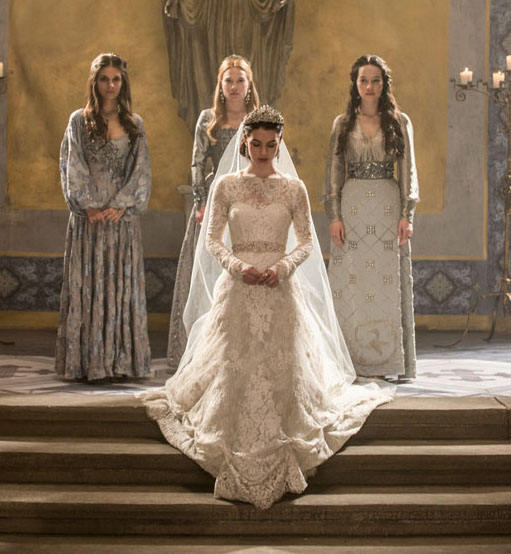
But it’s so hard to resist making fun of the show’s choices. Photo: Frock Flicks, which does a hilarious takedown of Mary’s wedding dress.
This trend is especially jarring when inconsistently applied in a film. The love interest in the 1996 French film Ridicule has straight hair, thick bangs, and simple make-up, but the unsympathetic characters of the French court look more accurate. A male example from the 90s would be Jack from Titanic, who has boyishly-floppy locks parted in the middle. Villain Cal, however, looks more period-appropriate. Clearly the film creators were okay with maintaining less-flattering historical looks for antagonistic characters, but not heroes.
Sometimes you gotta toss your anachronistic hair. Photo: Pinterest
This illustrates that anachronistic costuming choices are not necessarily borne from laziness. In addition to making main characters look attractive and sympathetic, inaccurate fashion can also help convey aspects of character. The titular character in Marie Antoinette (2006) owns a pair of Converse sneakers to emphasize that she is a childish teenager. A Knight’s Tale puts leading lady Jocelyn in punk-rock hairstyles to illustrate her rebelliousness.
Anachronistic fashion doesn’t have to be sloppy. But when accuracy is taken into account, the results are worth it.
Take the 1995 Pride and Prejudice miniseries. The tightly-curled hair might look funny at first, but it adds to the detailed Regency environment, the elements of which come together to bring Jane Austen’s world vibrantly to life.
Mad Men is a recent triumphant example. The actors are decked out in proper attire right down to their undergarments, as costume designer Janie Bryant understood how important this detail was to creating 1960s silhouettes. Here, historical accuracy is not exclusive with creativity, as costuming on Mad Men also reflect the characters’ personalities.
These examples use costuming not to make the characters look attractive to modern sensibilities, but to fully immerse viewers in the period. If anything else, shouldn’t film be immersive?
Creating commemorative likenesses – statues, wax figures, paintings – is no easy feat. The way an individual is remembered could have repercussions for years to come, so how does creativity factor in?
When we visit a wax museum, we’re usually prepared for a couple of duds that look nothing like they’re supposed to. Perhaps it’s due to the levity of such a space – after all, what purpose do wax museums serve apart from the fleeting amusement of seeing celebrities’ likenesses up close?
However, with commemorative likenesses such as statues, busts, or paintings meant to immortalize public figures, there’s a lot more to it. A grossly inaccurate portrayal could be damaging to a person’s public image, and depending on the nature of the commemoration, may be seen as unflattering or even disrespectful.
Take footballer Cristiano Ronaldo’s infamous bust, which was unveiled at Madeira Airport in Portugal last year. The bust was mercilessly ridiculed and made the subject of numerous memes, to the point that the artist had to redo it.
Portuguese footballer Cristiano Ronaldo was commemorated with this bust by sculptor Emanuel Santos in 2017. Public opinion ensured that it was replaced by a new, “more accurate” version, which can be seen below. Photo: Know Your Meme
Admittedly, famous individuals like these are exposed to these depictions by the very nature of their existence – they’re well-known, so people are going to make fun of them, whether it’s creating unflattering portrayals or vocally enjoying such parodies. That doesn’t make it right or excusable, especially if the public figure is a good person (if they aren’t, well, have at it!). Nevertheless, the fact remains that famous people lose the ability to regulate their public perception. The same goes for unauthorized biographies and the like – there isn’t much that can be done to prevent these interpretations unless someone wants to sue for libel.
Photo: Bleacher Report
The new, sleek Ronaldo statue reflects what we’re conditioned to expect when it comes to commemorative statues, though – a public monument is no hokey wax figure. We seem to expect accuracy and a display of strength or nobility in these types of depictions, which is why more gutsy interpretations often get shot down. Yet we can’t pull the plug on artists’ interpretations altogether. To do so would be to rob artists of their style and create a mild form of censorship that could inhibit creative thinking. (Whether we want to foster “creativity” when it comes to portraying likenesses for public commemoration is another question altogether).
Still, that won’t stop me from expressing my dislike for what I call the “Paper Airplane Portrayal” of Canada’s longest-serving Prime Minister, William Lyon Mackenzie King. Cristiano Ronaldo is one thing – as an athlete, he doesn’t carry the same kind of significance that a former national leader might. So King’s statue on Parliament Hill in Ottawa seems even more bizarre to me, since I would expect him to look a bit less cartoony and more like the other statues on the Hill. Sculptor Raoul Hunter was aiming to convey King’s forcefulness as a leader, according to this page on the Government of Canada website explaining the interpretations of the statues. The other monuments on the Hill portray their subjects more proportionately, whereas King can only be described as abstract. His monument makes me laugh at him a little, which, applied in the context of public office, is surely a less desirable outcome.
You don’t need a picture of King to know that nobody is shaped so angularly. Nor did King’s head appear so oblong in life. I will add, however, that this statue was created in 1967 when this style was in vogue, which could raise another fascinating discussion about how aesthetic standards affect portrayals during a given era. Photo: Flickr
Irrespective of whether we can gauge the accuracy of monuments beyond personal preference, discussing the issue tells us what we value as a society on a surface level. Commemorative monuments rely on context and setting to construct a noble or attractive memory of a person (often a man, statistically speaking) and their contributions in life. Let’s just hope that if we do anything noteworthy, the sculptor chosen to portray us won’t get too weird with it.
Some Harry Potter readers today assert that J.K. Rowling’s universe is not accurately diverse enough. Population research yields an interesting dialogue about the demographics in the series, but representation is an even more complex issue.
I’m about to do something which may surprise you: I’m going to criticize Harry Potter.
During my life I’ve spoken with many friends about my favourite book series, and in the last few years especially, the issue of diversity often looms large.
In Harry Potter the possibilities for discussing diversity are endless, from ethnicity, to LGBTQ+ inclusion, to gender, to species.
Today, I’d like to talk specifically about ethnic diversity. Why are there only, like, five* non-white kids at Hogwarts? (*Seven, but who’s counting?) The fact that there are so few minority characters isn’t ideal for the most popular book franchise of the twenty-first century so far. Even in the 1990s when the Harry Potter books are set, shouldn’t there be more diverse characters to represent the society the novels portray?
I definitely thought so … and then I embarked upon some research for this article and found this thread on Reddit, in which a fellow fan argues that the Harry Potter universe accurately reflects the ethnic demographic of the United Kingdom at the time. In the census for 1991, the year Harry Potter and the Philosopher’s Stone begins, 94.1% of Britons identified themselves as white, 5.9% as non-white.* (I don’t think the census asked about mixed ethnicity, since it was the first UK census to collect information about ethnic background.)
Dumbledore’s Army in the film adaptation of Harry Potter and the Order of the Phoenix. Photo: Harry Potter Wikia
With the 40 students in Harry’s year (5 of whom are non-white), that places the white population at 90% and the non-white population at 10%, which is actually almost double the proportion of non-white people in Britain at the time. What?!
Indisputably, Harry Potter is a product of its time. Though author J.K. Rowling’s illustrated demographic fits the temporal setting of the story, it doesn’t accurately represent its readers, who span the world over. Readers aren’t going to see the current population (of either Britain or the world) represented in the novels; they’re going to see the population of Britain 20 years ago. And with such a diverse present-day audience, we’re now left with a disparity in terms of ethnic representation.
I would therefore argue that the problem doesn’t necessarily lie in the number of non-white characters featured in the story, but rather the significance J.K. Rowling gives (or doesn’t give) them in the narrative. Let’s count the confirmed non-white students mentioned at Hogwarts in the books:
Dean Thomas
Blaise Zabini
Angelina Johnson
Lee Jordan
Cho Chang
Parvati Patil
Padma Patil
How many of these students have a major part in the story? None, really.
Cho Chang, as played by Katie Leung in Harry Potter and the Goblet of Fire. Photo: Warner Bros.
Cho Chang, Harry’s one-time love interest, features prominently in Order of the Phoenix but isn’t central to the other books. Rowling has received major criticism for her portrayal of Cho, with accusations of cultural ignorance in choosing her name, negatively depicting the only East Asian character in the books, and more.
Dean Thomas, who is Black, is consistently present as one of Harry’s friends; he shares a dormitory with Harry and Ron, and dates Ron’s sister Ginny for most of Half-Blood Prince. Dean has a rich backstory which was originally included in the books but didn’t survive the editor’s cuts. His story, in which he eventually learns his wizard father was killed fleeing the Death Eaters (Lord Voldemort’s followers), was omitted in favour of Neville Longbottom (a white character, interestingly) avenging his parents after Death Eaters tortured them into insanity.
Kingsley Shacklebolt, played by actor George Harris in Harry Potter and the Order of the Phoenix. Photo: Pottermore
The whiteness of Harry Potter goes beyond Hogwarts, too. Kingsley Shacklebolt, a Black wizard who is a powerful Auror and future Minister for Magic, is praised throughout the last three books, but he’s still a fairly minor character. There are also no identified South Asian characters in the Harry Potter universe apart from the Patil twins, and Latin American characters are non-existent. And I haven’t even started on mixed ethnicity: as a half-Indian (Goan) myself, I’m no stranger to the erasure of mixed identities. In fairness, delving into the specifics of minor characters’ heritage might have been a bit technical for a 1990s children’s book series. Relating this back to demographic research, there are deeper-rooted issues regarding the historical exclusion of mixed ethnicities on censuses in general (which could fill a whole other post, I’m sure).
All the main characters in Harry Potter are white. We’ve gone over historical demographics, but we should be asking a critical question here: why didn’t Rowling write any of the main characters, or even the major supporting characters, non-white?
After Hermione was portrayed as Black in the broadway play Harry Potter and the Cursed Child (a play that was approved, but not written, by Rowling), the author stated on Twitter that she “loves black Hermione”. I personally feel that Rowling latched onto the casting to retroactively interpret her novels as more inclusive than they were when she wrote them. Yes, she seems to support diversity now, but my reading of Rowling’s character descriptions has me convinced that she never wrote Hermione as non-white.*
It’s easy to approve a casting choice and take credit for diversity, but it’s a pretty passive act. In terms of the heavy lifting, Rowling hadn’t originally made strides to portray ethnic diversity in her books. Given all we’ve considered, that seems fair since she wrote the books in the 1990s – even in 2001 when the first film was released, Britain was still 90.9% white. Nevertheless, the later films, made 15 to 20 years after the books take place, haven’t increased ethnic diversity in the casting despite the chance to broaden the demographic for a contemporary audience. And it doesn’t change the fact that none of the non-white characters were given major roles in the books.
The main cast of the Harry Potter films (from left): Daniel Radcliffe, Rupert Grint, Emma Watson. Photo: Wikimedia Commons
Are questions of ethnicity more prevalent here in Canada (and the United States)? Possibly, since both nations were built on mass immigration. Does that mean North American readers scrutinize diversity more than those in Europe or worldwide? Maybe.
What do you think? Should the Harry Potter films have tried to reflect today’s population to bridge the gap between the whiteness of Britain in the 1990s and its current demographic? Should we throw the idea of accuracy out the window? Going forward, what should the cast of spinoffs like Fantastic Beasts and Where to Find Them look like? Are J.K. Rowling’s efforts at diverse representation tokenistic, or am I not giving her enough credit?
Who knows, maybe in 20 years we’ll get a remake that fulfills all its potential for representation, and the concept of a “diversity quota” will be so outdated that it’s laughable. Only time will tell.
This article is part of the Critiquing Harry Potter series. Read about gender representation in the Harry Potter franchise here.
____________________________________
FOOTNOTES
*As of the last census in 2011, 81.9% of the British population identified as White British.
*My reasoning regarding Hermione’s race, and my argument that J.K. Rowling is opportunistically interpreting her past work, is as follows:
“Hermione’s white face was sticking out from behind a tree.” This quote from Prisoner of Azkaban describes Hermione in a state of fear, and while it may be a turn of phrase for a stricken expression, it seems odd to describe a Black person having a white face no matter how bloodless or pale they’ve gone. There are countless other ways to describe fear or panic.
“… Ron looking incredibly freckly, Hermione very brown, both waving frantically…” Ron and Hermione have both just returned from holidays in sunny places; Ron from Egypt, Hermione from France. I’m certain Rowling is describing Hermione’s tan here, which implies that her “very brown” face is darker than her original skin tone.
Hermione appears as white in book covers. J.K. Rowling has the power to veto such a portrayal if it is inaccurate, and as Hermione’s race would be such a major difference, she would have noticed and corrected it.
Rowling approved white actress Emma Watson’s casting as Hermione for the films despite overriding other more minor character details (she told writers to remove a line where Dumbledore mentions a girl he once dated, since Dumbledore is gay!). She would have instructed casting directors re: Hermione’s appearance.
This sketch by Rowling, like all others by her, depicts Hermione with fair skin.
Some school boards won’t teach cursive writing anymore. The impact of this decision bears heavily on the ability to write and read handwritten documents, with possible implications for historical interpretation.
In our increasingly digital age, what will become of handwriting?
I’ve always found it fascinating to see people’s handwriting, and I associate the way they write with their personality, almost. At least, it’s a part of their identity. Being able to recognize people’s handwriting is also useful when you’re trying to tell who wrote something (it’s always interesting that Santa seems to have the same penmanship as Mum or Dad…).
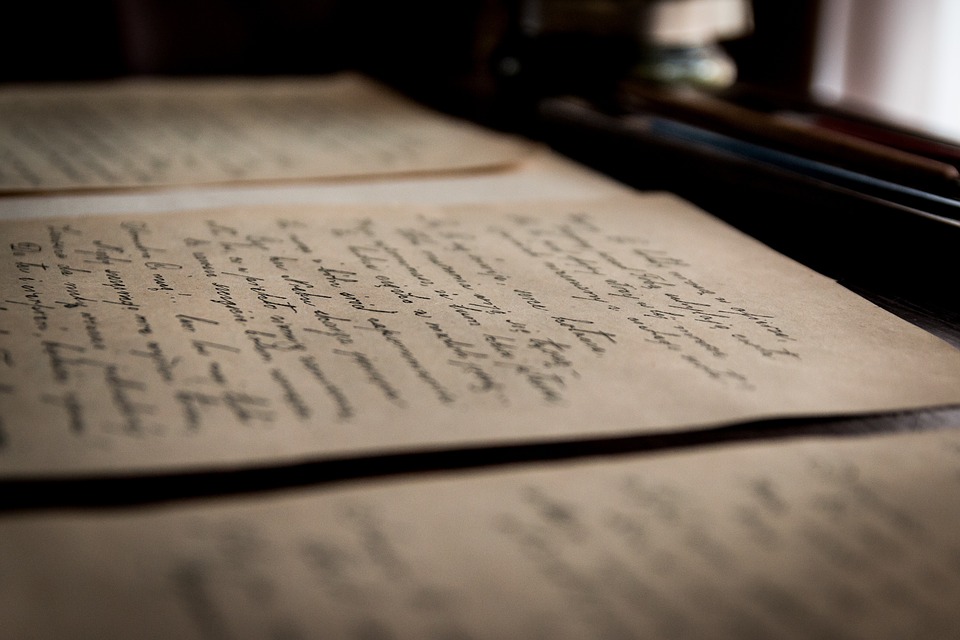
Photo: Michal Jarmoluk
Yet, with the domination of smartphones and laptops, we don’t have to hand-write notes or messages as often as before. As a lover of the written word, and a typography nerd, I feel a bit wistful reflecting on the disappearance of paper and pen.
One thing that strikes me is the choice of some school boards to cease teaching cursive writing to children. It’s something that’s happened in my own province of Ontario – kids are no longer going to learn cursive penmanship, meaning that they will have to resort to printing, in the case that they do write.
I myself write an approximation between printing and cursive writing, wherein I drag my pen to connect the letters (it’s much easier and quicker than printing, but it’s not by-the-book cursive). However, I know how to read cursive writing – but will the people of the future?
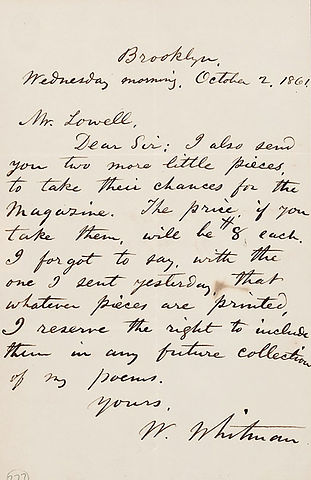
Take this letter from American poet Walt Whitman, for instance. We can probably decipher the text, as Whitman’s scrawl is fairly legible compared to countless other cursive letters, but we’ve also learned in school how to recognize the script (the letter “Q” in cursive always looked like a silly “2”, or a swan, but we get taught to recognize it – something our children won’t receive).
It’s difficult to say whether people who haven’t been taught cursive writing will be able to read letters like these. Whitman’s hand is one thing, but how about those who wrote much more sloppily in the past, or with a much steeper slant?
“Woman Writing a Letter with her Maid”, Johannes Vermeer. Photo: Wikimedia Commons
Not too long ago, I was at the Thomas Fisher Rare Book Library at the University of Toronto, where I completed my master’s degree. I spent a few days reading through the correspondence of General James Wolfe, the leader of the victorious British forces at the fabled Battle of the Plains of Abraham (1763) which defined the colonial future of Quebec and ultimately Canada. Wolfe’s writing was quite elegant, but I often had trouble deciphering some of his words (I’d like to illustrate my point, but the original copies of his letters are protected in the library, so I don’t have photographs).
Letters like these, and early manuscripts, are extremely important documents to study, both in a literary and historical sense. In the humanities, we’re working with written documents all the time, and being able to read as much as we can is a necessity. Even just for leisure, being able to write and read cursive is a special and worthwhile skill. It’ll be interesting to see how reading evolves in the future when most of the documents we produce will be typed.
It’s a little ironic: I almost wish I could have handwritten this post for effect.












 The Mindful Rambler