How did you make it compelling? Which parts did you include, and which parts did you omit? And what about timing? (It’s supposed to be everything, isn’t it?) I’m guessing you were definitely hoping for the best punchline and the best response to your story.
Storytelling is an inherently creative process. And I think that the reception of a story depends heavily on the storyteller. What perspective are they coming from? Who are they trying to reach? Audience – and knowing your audience – is just as integral to the success of a story.
Photo: Serena Ypelaar
Personal storytelling is something of a curatorial process, trying to synthesize one’s own experience and present it coherently to others so they can share in it.
For instance, I just got back from a month in Scotland, and I have a plethora of stories to tell my family and friends. Since there are so many, they’ll likely unravel slowly over time as I’m reminded of things I did or saw (or, let’s be honest, ate). Naturally I’ll be looking to impart the essence of my experience – how enlightening it was, how beautiful the landscapes were, how friendly people are … the list of stories it’s possible to share goes on.
Yours truly on a ramble through the woods. Photo: Serena Ypelaar
I’ve been thinking a lot lately about personal storytelling and what it means for us as humans. We’ve mostly been discussing public storytelling here on The Mindful Rambler, on a large scale; but as we’re today celebrating the blog’s 1st birthday, I want to reframe things a bit so we also consider storytelling on a more personal level.
What is the significance of our own stories? And how do literary masters, artists, and creators pour themselves into their own storytelling to share a piece of their lives – their struggles, their triumphs, their losses, their love? The art reflects the artist; not only can we learn something about the world when we consume and interpret stories, we also get to know another person, sometimes without ever having met them. Humanity needs stories.
We’ll be rambling more on these themes soon. Thank you all for reading The Mindful Rambler in its first year – I hope you’ve enjoyed it! My fellow ramblers and I – Adriana, Sadie, Lilia, Jenny, and Bretton – look forward to telling even more stories over the next year.
Technology connects us like never before. Halt and Catch Fire takes place during the computer boom that started it all, emphasizing the importance of human connection.
When AMC released Halt and Catch Fire in 2014, people were quick to dismiss it as “Mad Men but in the 80s! With tech!” Now, it’s no secret that weloveMad Men here at the Rambler, but I think the comparisons did Halt and Catch Fire a disservice. The show remained criminally underrated and under-watched for four seasons, over which it grew into one of the most profoundly human shows on television.
From left: Lee Pace, Mackenzie Davis, Kerry Bishé, and Scoot McNairy, stars of Halt and Catch Fire. Photo: AMC
It starts at an interesting moment in history: the 1980s, when computers are not yet ubiquitous but the industry is on the cusp of … something. We know, of course, just how important computers will become, that the tech industry will explode and eventually everyone will have computers not only in their homes but in their pockets. The characters in the middle of that history, however, remain in a constant struggle to get ahead of the curve, to create the thing that will change everything. A lot of period shows rely on this kind of dramatic irony, where viewers know what the characters don’t. We can’t reach through the screen and tell them that Bill Gates and Steve Jobs will beat them to the punch. But it’s fascinating to watch them keep trying anyway.
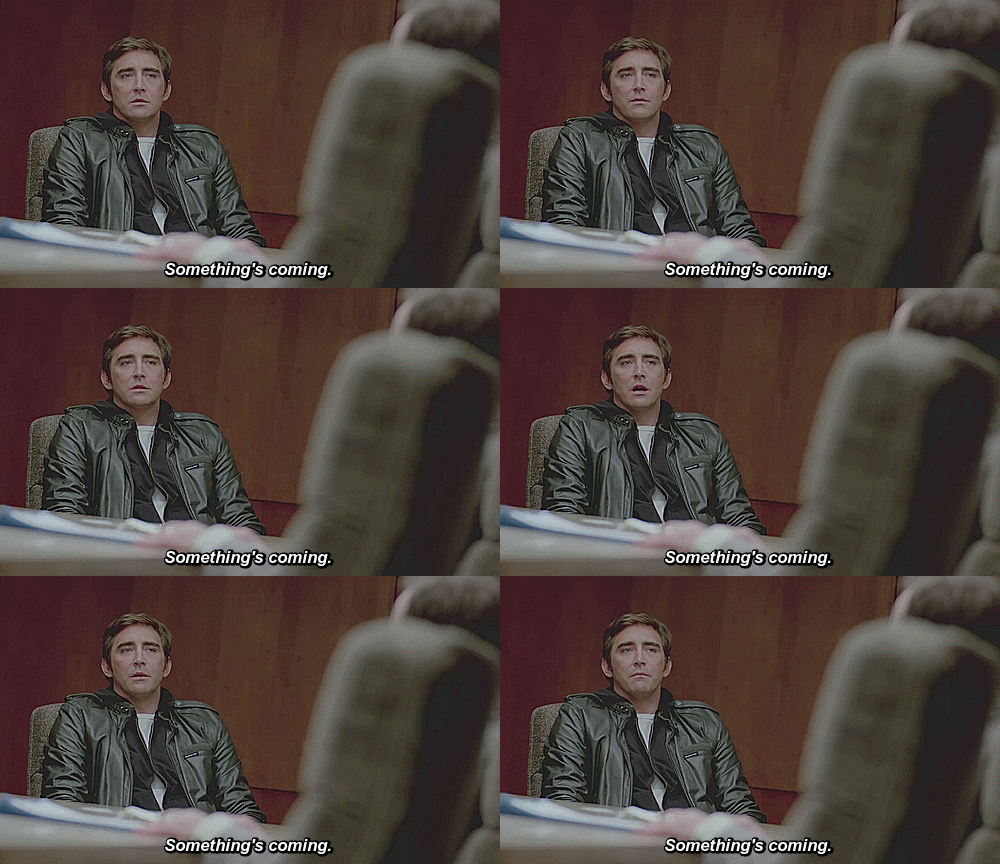
Joe MacMillan (Lee Pace) predicts the future. Photo: Giphy
Somewhere along the way, though, Halt and Catch Fire realized that the real draw was not seeing the slow birth of the Information Age, but the people at the heart of it. The dreamers and creators who so badly want to leave a mark and change the world and end up changing themselves in the process.
Joe MacMillan (the always amazing Lee Pace) starts off as a fairly typical male antihero akin to those that dominate prestige television—you know, Tony Soprano, Walter White, or, yeah, Don Draper. Joe is a visionary who manipulates, cheats, and talks his way into a fledgling Texas software company in order to transform it into a PC company to rival IBM. But the show quickly stopped trying to emulate other prestige dramas and Joe, rather than a villain or even an antihero, became the voice of the show’s underdog humanity. Joe sees what others don’t, that technology has the potential to change the way we interact with one another. So it’s fitting that Joe is the one to utter the words that could serve as Halt and Catch Fire’s thesis statement: “Computers aren’t the thing. They’re the thing that gets us to the thing.”
That thing, in my view, is connection. Throughout its run, Halt and Catch Fire consistently emphasizes that behind all those screens and wires and lines of code are human beings, desperately seeking connection in a world that is often forbidding. It’s no surprise that Joe, an openly bisexual man, would eventually want to build something that brings people together and lets them be who they really are.
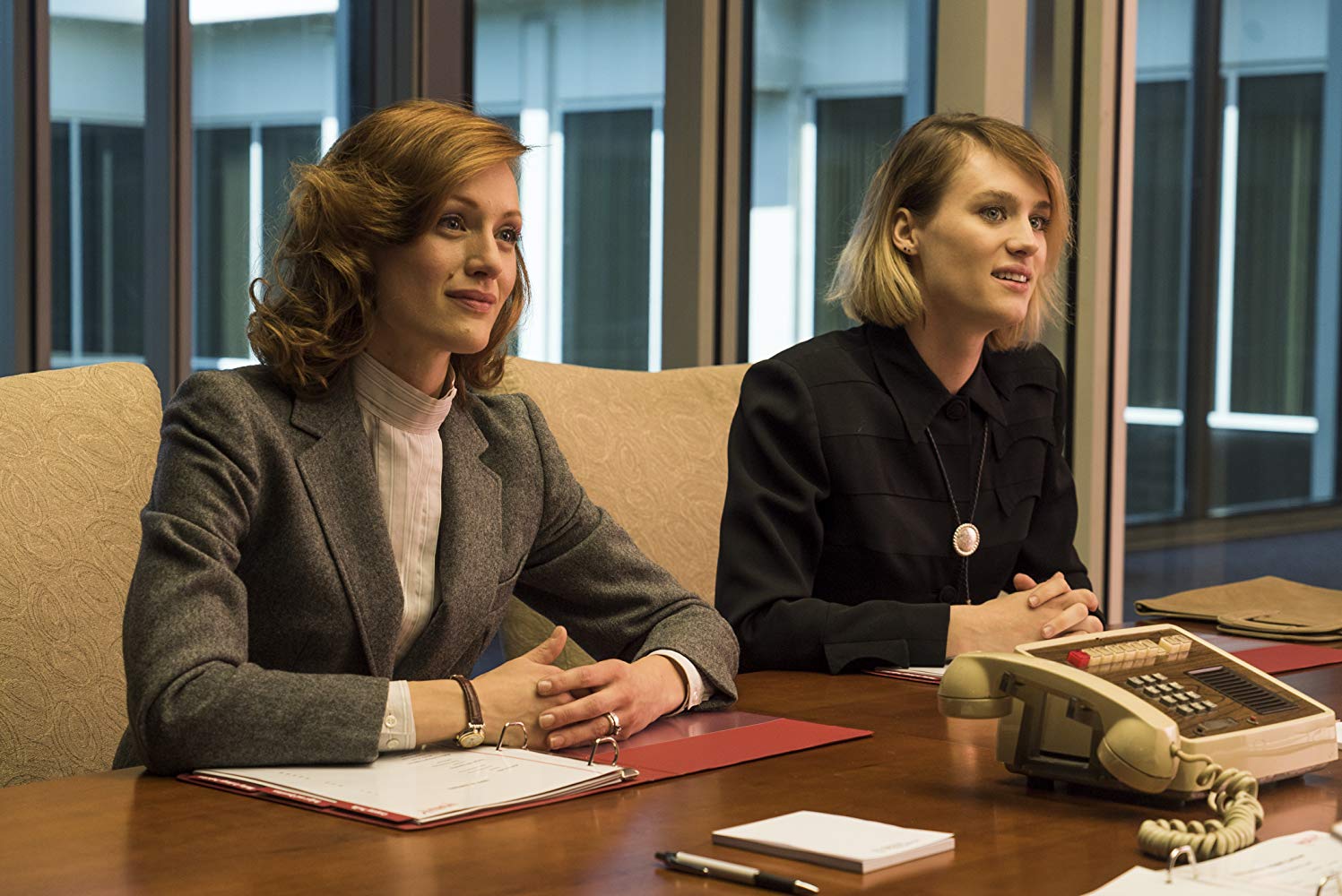
Donna Clark (Kerry Bishé) and Cameron Howe (Mackenzie Davis) in Halt and Catch Fire. Photo: IMDb
It’s easy to be cynical about the Internet these days. But we forget that it can be a wonderful space for people to share their creativity and interests and connect with other people they might otherwise never meet. Over and over again, Halt and Catch Fire shows us that what matters is less the technology that connects us than it is the people who use it.
Historically, death masks were used to remember those who had passed away, or to create likenesses in portraits. Life masks are their slightly less macabre twin, and they both close an interpretive gap in physical memory.
When I first set foot in Keats House in Hampstead, London almost exactly a year ago, I had long been fascinated by death masks – but life masks would prove to bring a whole other thrill.
Posthumous portrait of the poet John Keats by William Hilton. Photo: Wikimedia Commons
You might wonder why the distinction between the two holds any significance. One type of mask is taken from a deceased subject’s face, while the other involves the face of a living individual. What’s the big difference?
From an interpretive standpoint, the fact that historical figures posed for life masks while living and breathing – that they perhaps might have made a remark or laughed just before the cast was taken – is staggering. The result, while it may seem trifling at the time, is an unrivaled connection to the subject – it outlives them. A life mask of a historical figure preserves their face in its tangible and living form beyond a photograph or painting, allowing us to interact with it.
Let’s give these abstract notions some context. I first came across the poet John Keats (1795-1821) and his work while studying British literature in undergrad. I quickly came to love Romantic poetry, in which nature, emotion, and the metaphysical take centre stage. Keats’ 1820 Ode on a Grecian Urn (in which the speaker marvels at the beauty of an artifact in the British Museum) captures everything I love about museums and literature.
Keats House in Hampstead Heath, London, where the poet lived from 1818-1820. Photo: Serena Ypelaar
So there I stood in Keats House, ready to connect with my favourite poet in a long-awaited moment of fulfillment. I couldn’t have hoped for a better outcome. For one thing, the house’s interpretation was excellent – I had expected a rather dated presentation of the Romantic poet’s life, but the displays are new, appealing, and most importantly, emotionally evocative. Sensory elements are manifold as we’re given opportunities to visualize Keats’ presence and listen to audio of a first-person interpreter reading his poems and personal writings. And most strikingly, there are masks.
On the ground floor is Keats’ life mask. As a forever fangirl of the poet who lived there from 1818 to 1820, I was instantly drawn to it. (I can’t believe I’m telling you this, because it sounds irredeemably creepy.) My strange urge to reach out for the mask was validated (thank God, I’m not crazy after all!) when I read the label next to it: please touch.
John Keats’ life mask on display at Keats House, next to a label encouraging visitors to touch. Photo: Serena Ypelaar
And that was how I ended up in Keats’ house touching his face. To further justify my museum nerdiness + mild infatuation, I can only describe the experience as unique and surreal.
With a life mask, you can engage with those who’ve predeceased you, whether you feel the contours of their face or just look. It’s so rare to find this kind of connection with individuals who died before photography gathered steam. Maybe Keats House really knew their audience, but the experience far surpassed trying to picture someone’s face based on portraits: here was the unembellished truth of what Keats really looked like. Since no photographs of him exist, the mask is an invaluable instrument of truth.
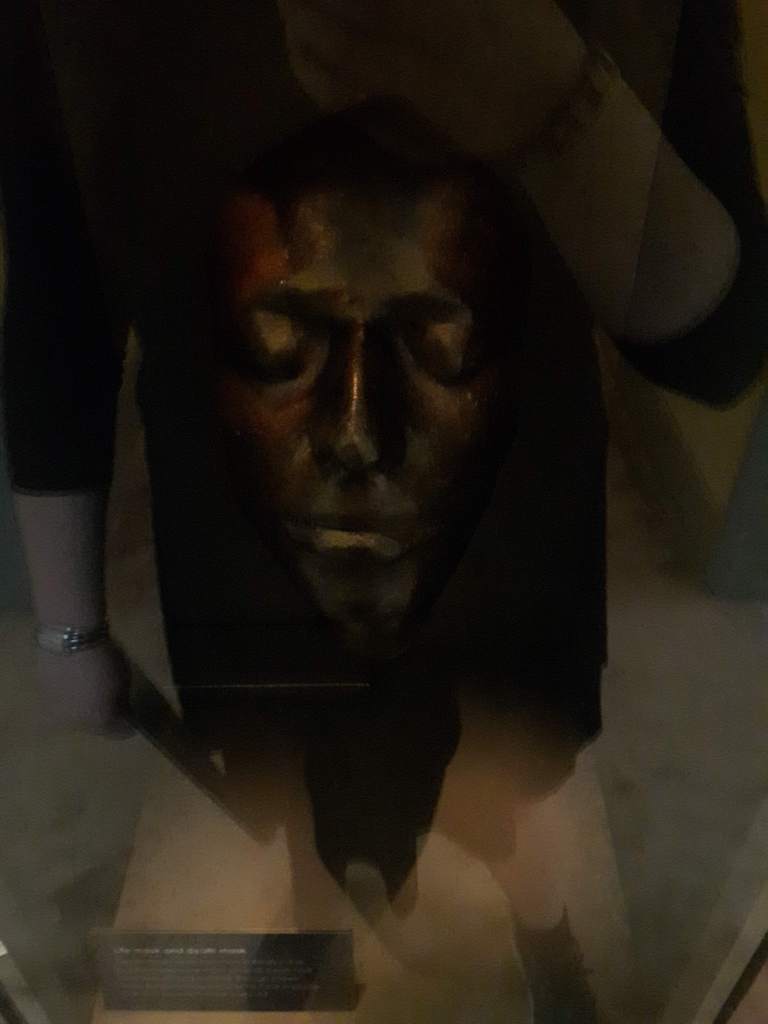
Keats’ death mask as reflected in my (perhaps appropriately black) dress. It’s a jarring contrast to the life mask. Photo: Serena Ypelaar
Upstairs was a much more sobering reality, but affecting all the same. The lighthearted yet poignant discovery of the life mask was now replaced by a sombre shift: here, behind glass, was Keats’ death mask. Keats died of tuberculosis aged 25. The difference in his face was noticeable. His once robust features were gaunt and thinner, a mark of the illness that claimed his life; and like the life mask, coming face to face with Keats (now in death) was jarring. It’s appropriate that this iteration was inaccessible by touch, for obvious ethical (and perhaps even spiritual) reasons. No one needs to touch a death mask, unless they’re a collections manager! Regardless, I was glad to have the rare privilege of seeing both a life and death mask of the same person, however grim the comparison.
Life and death masks offer an indisputable connection to the subject(s) of both. The concept is a goldmine as far as historical and biographical interpretation goes. In front of us is the near-objective image of a person’s likeness, almost as if they were before our eyes. One thing’s for sure: when looking at Keats’ life mask, I felt as mesmerized as the speaker looking at the Grecian urn in the British Museum – viewing a moment in time. I hope to see more life (and death) masks of public figures in the future, because their immersive value is priceless.
When old age shall this generation waste, Thou shalt remain, in midst of other woe Than ours, a friend to man, to whom thou say’st, “Beauty is truth, truth beauty — that is all Ye know on earth, and all ye need to know.”
Why, of course you can! Baz Luhrmann’s The Great Gatsby (2013) demonstrates that while it may seem unorthodox to decide against a by-the-book 1920s soundtrack, the choice to incorporate contemporary artists worked.
When a new adaptation of The Great Gatsby got the green light (pun intended), I was over the moon. High School Me was obsessed with F. Scott Fitzgerald’s 1925 novel, despite never being assigned to read it (or perhaps that’s why I actually liked it: it wasn’t just schoolwork).
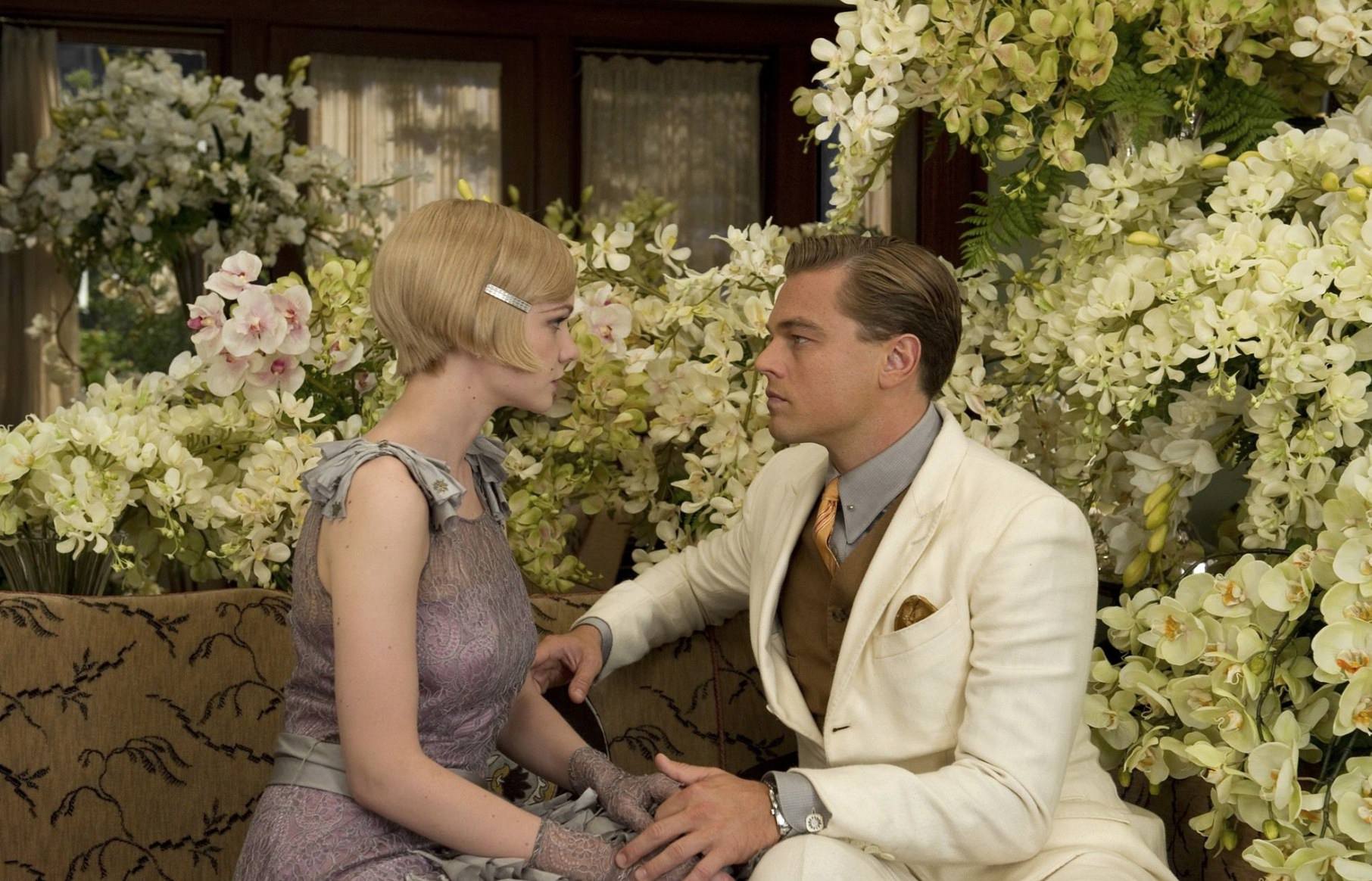
Daisy Buchanan (Carey Mulligan) and Jay Gatsby (Leonardo DiCaprio). Photo: The Gentleman’s Journal
Leonardo DiCaprio was cast as Jay Gatsby, Tobey Maguire was to play narrator Nick Carraway, and Carey Mulligan was Daisy; matches made in heaven, basically. But one thing I just wasn’t sure about was the soundtrack. When I saw a couple of early trailers for the film, I was mildly indignant. Eager as I was, I was a purist and had expected authentic 1920s music to furnish the lavish Baz Luhrmann film. But that’s the understanding I lacked: I hadn’t seen Moulin Rouge or any of Luhrmann’s other films at that time, so his style was unknown to me. What do you mean, they’re using modern music in such a sacred film, one rooted so inextricably in the Jazz Age? I was positively affronted. How would that ever work?
But then came May, and I saw the movie. And it worked; by God, did it ever work. I don’t know how, but I finally understood the vision and appreciated the 1920s flair added to each track, as produced by Jay-Z. Joining him were Kanye West, Beyoncé and André 3000, Lana Del Rey, will.i.am, Fergie, Gotye, Sia, Florence + the Machine, Emeli Sandé, Bryan Ferry, The xx, and Jack White. In other words, a gilded lineup if I ever saw (or heard) one.
Nick Carraway (Tobey Maguire) and Jay Gatsby (Leo DiCaprio) in New York. Photo: Pinterest
Del Rey’s “Young and Beautiful” is achingly wistful; The xx’s “Together” is languid and romantic. On the flip side, Fergie and will.i.am’s tracks brought the party to life, and Jay-Z, Kanye, and Beyoncé capture the enigmatic allure of both Gatsby and New York City. Jay-Z and Kanye’s “No Church in the Wild” overlaid a city montage so memorably that I picture the scene whenever I hear the track.
The soundtrack is used (in conjunction with original novel quotes) to great effect at Gatsby’s party, seen here.
As seen through Nick’s eyes, Gatsby’s party is a perfect example of the soundtrack at play. In my reading of the novel, Fitzgerald knew exactly the right balance to strike between well-placed pithiness and sprawlingly eloquent description. The film soundtrack is the perfect complement: opulence, combined with Fitzgerald’s judicious prose, creates a picture of how the party might look and sound.
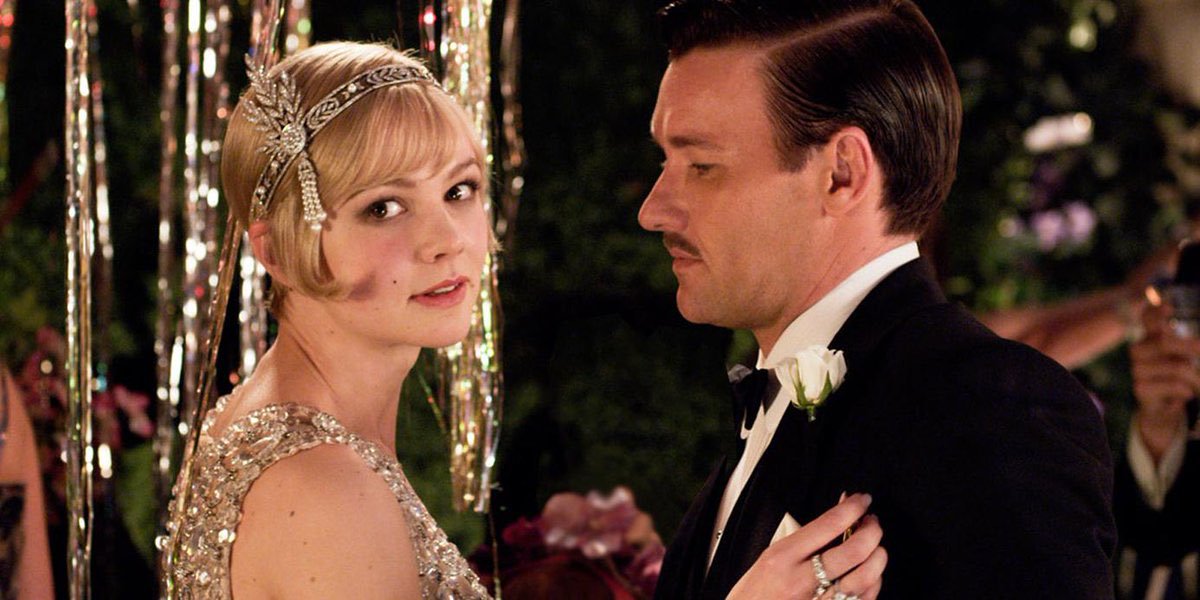
The Buchanans, Daisy (Carey Mulligan) and Tom (Joel Edgerton). Photo: Pinterest
Surrendering my preconceived notions was easy once swept up by the film in its totality. I appreciate how the soundtrack was able to unseat my stubborn misgivings, and I think creatively, it was a phenomenal success. When I imagine the alternative, my originally preferred 1920s jazz, I can admit that the film might then have come across as static compared to this adaptation, which lies fluidly between Fitzgerald’s era and ours. It’s a bridge to audiences, who can relate to these familiar musicians in a setting that may be largely unfamiliar. In less capable hands, it could have been a disaster. But elements of each song nod to the novel, from Florence’s “green light” in “Over the Love” to Gatsby’s ultimate fate, tacitly referenced in will.i.am’s “Bang Bang”. Interspersed with Craig Armstrong’s alternately bubbly and haunting score, the soundtrack represents all the warring interests and desires of the film, looping backstory into the ominous plot progression.
Some people didn’t even like this film. But Luhrmann’s Gatsby is staunchly faithful to the source material as far as the screenplay goes. The characters spoke many lines verbatim from the book, which warmed my purist heart; the costumes were wonderfully executed. Any liberality had to be assigned elsewhere, and I’m actually glad it was the music. This soundtrack might not have thrived with a direct repeat of past music. Instead, it acknowledges history and moves forward with it to inform something new, which the misguided Gatsby failed to do as he tried to reconstruct the past.
Gatsby (DiCaprio) reaches for the green light across the bay, obsessed with getting back to Daisy as if nothing had changed. Photo: Odyssey
This soundtrack will always be relevant to me as a reminder that our fixation on what things should be isn’t always what’s best – there are so many new and daring possibilities out there.
During WWII, Allied secret agents were tested to their limits. The best way to foster empathy for the hardships they faced is to undergo them yourself – just ask the contestants on Churchill’s Secret Agents: The New Recruits.
The only people who know what World War II was really like are the ones who lived through it. Army, navy, air force, nurses, medical corps, civilians … and spies. Everyone living between 1939 and 1945 had a diverse experience of one of the largest global conflicts in history, and for someone like myself, that experience is nearly unfathomable.
Nearly.
We have historical records and witness testimony to illustrate the war to those of us who hadn’t yet been born or were too young to remember anything. The mass genocide of Jewish people and the horrors suffered at the hands of Adolf Hitler and the Nazis have left lasting scars. But the Allies defeated the Axis powers in 1945, restoring peace.
A few of the contestants on Churchill’s Secret Agents: The New Recruits. From left: instructor Nicky Moffat, Samy Ali, Debbey Clitheroe, Alastair Stanley, and Magda Thomas. Photo: Polygon
At the heart of the war effort was Britain, who dispatched secret agents from Allied countries throughout occupied Europe to bring down enemy forces and top-ranking Nazi officials. In 1940, Prime Minister Winston Churchill and Minister of Economic Warfare Hugh Dalton created the Special Operations Executive (SOE), an espionage organization. SOE agents faced countless tests and challenges both in training and in the field, challenges we can scarce imagine – until last year, when the Netflix/BBC miniseries Churchill’s Secret Agents: The New Recruits premiered.
A unique reality show, Churchill’s Secret Agents focuses not on interpersonal drama, backstabbing, or creative skill, but rather, on suitability to become an SOE operative as per the 1940s standards. Supervised by Nicky Moffat, the British army’s highest ranking woman before her resignation in 2012, Lt. Col. Adrian Weale, commanding officer, and Mike Rennie, military psychologist, the show is essentially a training simulation for the 14 recruits hoping to be selected as SOE agents. As an exercise in empathy, it’s incredibly effective – it offers not only the recruits, but the audience, with fascinating (and sometimes shocking) insights into the life of an SOE spy. I’ve watched the five-episode series three times already; I loved seeing how each recruit navigates each test, and who excels at what.
SOE Historian Rod Bailey consults on the show. Photo: Popsugar
The show is diversely cast, which in this case is historically authentic. The SOE recruited both men and women from various walks of life to blend in behind enemy lines. Their main concerns were talent and aptitude. On the show, the new recruits include Rohini Bajaj, a doctor; 21-year-old maths graduate Alastair Stanley; Polish-born translator Madga Thomas; ex-military Rob Copsey, who lost his leg serving in Rwanda, grandmother and drama teacher Debbey Clitheroe; paralegal Will Beresford-Davies, and research scientist Lizzie Jeffreys, among others of varying professions, cultural backgrounds, and ages.
Recruits Rohini Bajaj, Rob Copsey, Lizzie Jeffreys, and Will Beresford-Davies. Photo: The Guardian
The series seems to offer the best of both worlds, too – each training exercise is contextualized with documentary-style footage including narration about the SOE’s impact on the war effort, specific missions that succeeded and failed, and prominent agents who were later recognized for their service.
Reality shows can be an invaluable method of historical interpretation; what better way to understand history than to see it recreated, and even more importantly, to interact with it? As a spectator, I fortunately don’t have to scale a mountainside in the pouring rain, but I can still appreciate the emotional and physical strength needed as I watch the recruits attempt it. For the contestants themselves, their understanding is even more immersive, as they literally have to participate in the testing process and challenges.
Recruits receive training (and are later tested) on hand to hand combat, firearms and explosives, stealth, disguise, interrogation, lockpicking, physical tasks such as scaling walls/cliffs and crawling under barbed wire, and Morse code/transmission.
The first of five episodes is shown here. You can stream the show on Netflix or watch the entire series on YouTube.
It’s hard to pin down the best part of the show, as I’ve already outlined its benefits for historical appreciation. However, I think Churchill’s Secret Agents‘ biggest strength lies in its emotional impact. If you’ve read The Mindful Rambler enough, you’ll know that I’m a big crier, but suffice it to say that this overview of the Resistance and the efforts of those who fought against injustice had me welling up. Not only that, but the fact that these modern-day people of varying backgrounds could complete the rigorous training pretty much floored me. It made me realize that we can exceed our limits if we resolve to, and we can do what’s necessary to fight for good, even if it’s difficult.
I don’t know if I could really navigate such difficult training on such a short timeline – but I like to think that if it was needed, I would try my hardest.
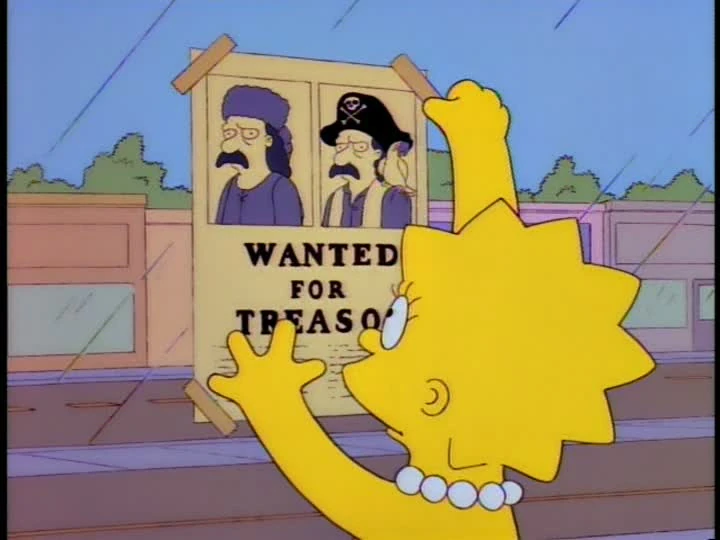
This being my inaugural post with The Mindful Rambler, I find it quite appropriate that I have the opportunity to write about The Simpsons! As my friends and well wishers will tell you, Simpsons references are insidious in my day-to-day vernacular. These same friends also know that museums play an equally prominent role in my identity. What happens when we combine The Simpsons with museology? Well, simply put, we get this post.
As The Simpsons winds up its 30th season, I thought it would be fun to look at how museums operate in the world of the show. Every type of museum, cultural centre, tourist trap, and historic site under the sun has made, at the very least, a handsome cameo during the show’s run.
Following are three of my favourite museum moments featured in the show and why I think they are a perfect marriage between The Simpsons and museums.
The Orb of Isis from “Lost Our Lisa” (Season 4, Episode 24)
The Orb of Isis, a mystery that Homer decides he needs to solve. Source: Giphy
The mythical Orb of Isis is the centrepiece object of the “Treasures of Isis” exhibit, a showcase of artifacts from the Egyptian Temple of Isis. Lisa misses seeing the exhibit but Homer convinces her to join him and sneak into the Springsonian Museum before the artifacts are packed and sent to the next tour stop. Much to Lisa’s protest, Homer betrays the unwritten rule not to cross the “velvet rope” in order to get up close with the alluring object and figure out its secret. While the scenario is a bit reaching, Lisa’s attention to museum etiquette in this stereotypical portrayal of archeological exhibitions is enough to make any museum professional appreciate the intersection of object preservation and innocent curiosity.
Lisa will forever be the voice of reason. Source: Giphy
Springfield Elementary Field Trip to Fort Springfield from “The PTA Disbands” (Season 6, Episode 21)
Throughout the history of the show, we see a number of representations of historical military forts. In “The PTA Disbands,” the students of Springfield Elementary visit the historical site Fort Springfield, a Civil War-era living history museum. Upon arriving, Principal Skinner is shocked to learn that a for-profit company has assumed management and what was once a free museum experience is now a cash grab out of reach for the school to pay.
A real scenario that museum management juggles, The Simpsons find a way to make it humourous. Source: Simpsons Fandom
This is a very real scenario that museums are seeing. Balancing rising operational costs and profit-driven leadership often leads to some level of inaccessibility to an institution’s programming and exhibitions.
Lisa versus Jebediah Springfield and the Springfield Historical Society from “Lisa the Iconoclast” (Season 7, Episode 16)
Plot, character development, and quotability aside, this episode examines difficult aspects of museum work, preserving history, and interpreting stories. While one could dive deep into a discourse of this episode, alone, the episode intelligently explores the idea of the legacy, truth, and representation of local hero Jebediah Springfield. If you watch only one episode on this list, make it this one.
Lisa on a quest to break misinformation around the town’s founder that has been preserved in the collective memory. Source: Wikia
Whether it be a pivotal plot point or a hilarious one-off gag in an episode, museums are given their due on The Simpsons. Clever commentary on the cultural field at large, and tongue-in-cheek satire of museum practice make for an amusing and thought-provoking experience for all viewers.
What are some of your favourite museum moments featured on The Simpsons? Let us know in the comments below.
Though Shakespeare has been dead for over 400 years, modern renditions of his plays are still alive and well. BBC’s The Hollow Crown adapts Shakespeare’s history plays, which prompt us to examine the Bard as not only playwright, but historical interpreter.
As we
approach William Shakespeare’s 455th birthday – thought to be April 23, the
same day as his death – one can’t deny his unparalleled legacy. Shakespeare is
still studied in schools worldwide. His words and idioms still pervade the English
language. And people are still adapting his works on stage and screen.
As a self-professed Shakespeare devotee, I’ve seen several productions, personal highlights being Hamlet at theGlobe Theatre in London; Colm Feore in Macbeth at the Stratford Festival in Ontario; and A Midsummer Night’s Dream at Shakespeare in High Park. I have yet to see King Lear and Richard III (my favourites) on stage, but thanks to Shakespeare’s robust canon, we’re also blessed with film and television adaptations – like The Hollow Crown.
Tom Hiddleston as Henry V in The Hollow Crown. Photo: BBC
Most of Shakespeare’s best-loved plays are his comedies and tragedies. When I first heard about The Hollow Crown, which adapts Shakespeare’s tetralogies, I knew I had to see it. Starring Tom Hiddleston, Benedict Cumberbatch, Jeremy Irons, Tom Sturridge, Sophie Okonedo, and Dame Judi Dench, The Hollow Crown covers Richard II, Henry IV Part 1, Henry IV Part 2, and Henry V in the first cycle; and Henry VI Part 1, Henry VI Part 2, Henry VI Part 3, and Richard III in the second cycle.
Shakespeare’s history plays don’t receive as much appreciation, but they’re fascinating because they demonstrate the playwright in action as a historical interpreter. Taking historical events and condensing them into dramatic plays is a sensitive act of storytelling, albeit heavily influenced by reigning powers at the time. Shakespeare composed his plays during the Tudor and Stuarteras, and his work thus appealed to Tudor and then Stuart sensibilities. Under Queen Elizabeth I, Shakespeare furthered the Tudor Myth, which essentially comprises propaganda that glorified the Tudors and sought to legitimize their claim to the throne – which meant historical figures like Richard III, the Plantagenet king slain by Henry Tudor (Henry VII) were heavily vilified. Shakespeare’s contribution is Richard III, a play depicting Richard as deformed and mercilessly evil.*
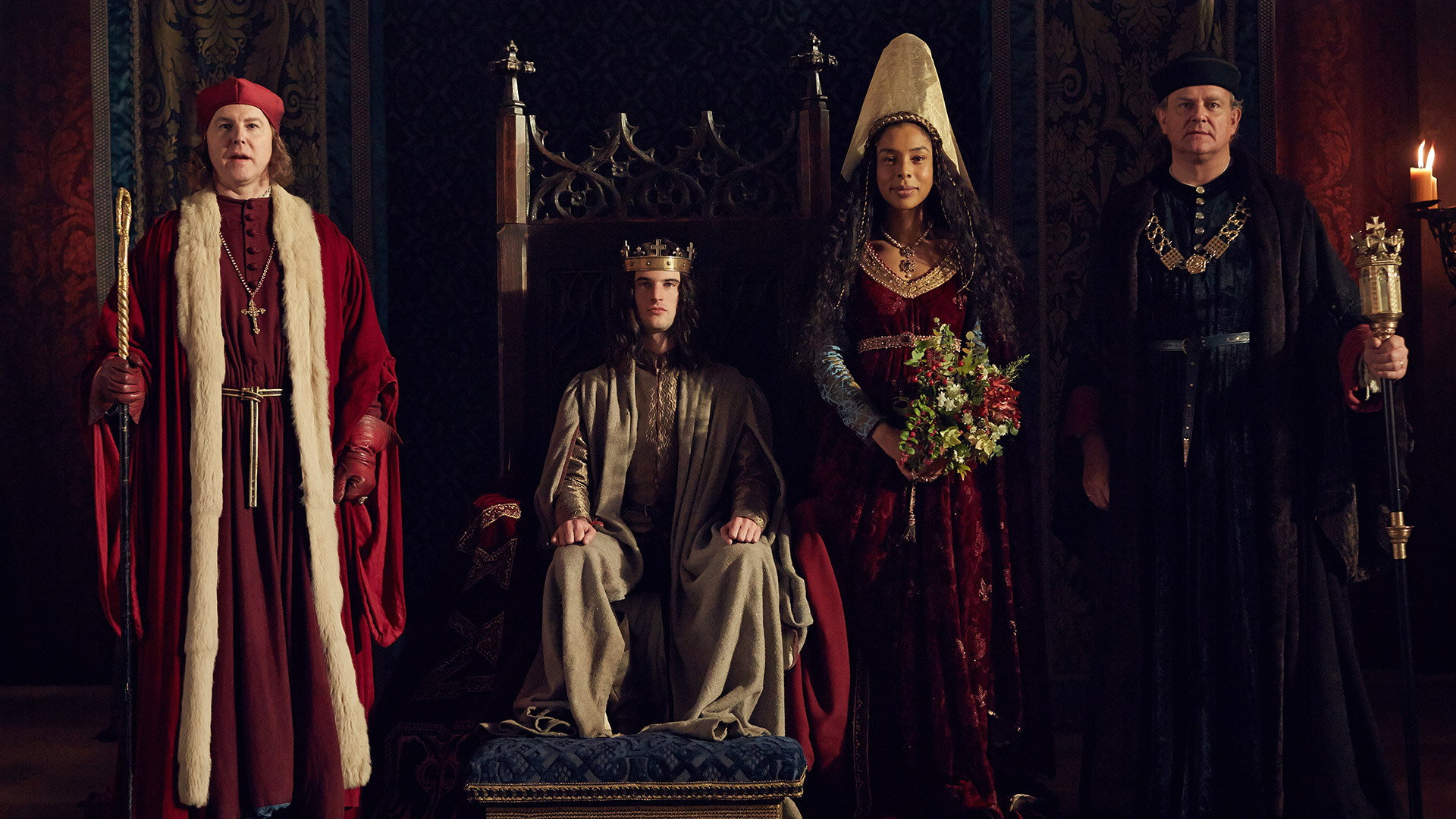
The Bishop of Winchester (Samuel West), Henry VI (Tom Sturridge), Queen Margaret (Sophie Okonedo), and the Duke of Gloucester (Hugh Bonneville) in The Hollow Crown’s adaptation of Henry VI. Photo: Robert Viglasky
Since Shakespeare’s history plays were political tools used to flatter and curry favour with kings and queens, their content is open to discussion. However, to those unfamiliar with early English monarchs, the plays can also familiarize audiences with important histories. I admittedly never could get Henry IV, Henry V, and Henry VI straight (so many Henrys!), but after watching The Hollow Crown, I’ve grasped enough of an overview to launch further research (of the Wikipedia variety for casual learning). Much of my medieval history knowledge has therefore been shaped by Shakespeare, for better or for worse.
Like any historical adaptation, it’s important to understand the changes Shakespeare made for the sake of drama (and political appeasement). A completely accurate account may not make for the best entertainment, especially on an Elizabethan or Jacobean stage. All the same, I admire how Shakespeare’s tetralogies are all interwoven. In The Hollow Crown: The Wars of the Roses, for instance, we see the future King Richard III witnessing his father Richard of York’s death at the hands of the Lancastrians; revenge is a major theme in the plays, which The Hollow Crown illustrates well.
Benedict Cumberbatch as Richard III in The Hollow Crown: The Wars of the Roses. Photo: Robert Viglasky
As a screen adaptation, the delivery differs from stage productions, but the performances are so excellent that the production is still effective. Most notably, Benedict Cumberbatch’s monologues as the dastardly Richard III gave me chills. In typical Shakespearean asides which break the fourth wall, Richard’s eye contact with the viewer fosters an unsettling connection, even through a television screen. Likewise, Tom Sturridge’s depiction of both compassion and weakness as Henry VI demonstrated complexity in a sympathetic way, and so I felt – from the comfort of my sofa – swept up into the dramatic interpretation of dynastic conflicts from centuries past.
Nevertheless, Shakespeare’s plays transcend entertainment because they are prominent accounts of history. Like any historian’s account of events, the Bard’s plays continue to inform our remembrance of English political history. The Hollow Crown is a reminder of this phenomenon and the weight that the legendary playwright’s voice carries. That leaves Shakespeare as not only a dramatist, but a historical interpreter shaping contemporary perceptions of history – both in the late 16th and early 17th century, but also as long as his plays continue to be performed and read.
*During the
Book History and Print Culture part of my master’s degree I specialized in Richard III and how Shakespeare’s
portrayal influences public memory of the Yorkist king, and I’ll be writing about
him in detail in the future.
Gentle reader, we are both on the internet in 2019, so I assume you too have absorbed a lot of essays about Why It Is Important to Have Representative Media. This is so true and well-trodden that I must glide over it and write this essay about something else entirely.
I’ve been thinking about how diversity helps us reframe and reimagine older cultural works, written in even more exclusionary times and places, and also I have been thinking about the Stratford Festival’s 2018 production of The Music Man (directed by Donna Feore).
If you’re not familiar with the plot of The Music Man and do not have a Theatre Kid™ in your life to explain it, I am here to help. It is a Broadway musical about a con man called Harold Hill who rocks up in River City, Iowa, intending to sell uniforms and equipment for a boys’ marching band before skipping town. Imagine Footloose, if Kevin Bacon wanted to sell you a tuba instead of spreading the joy of dance.
Harold promptly falls in love with the town’s librarian, Marian (I know!), which gives him a reason to stay in town – except that he lacks the requisite musical skill to teach River City’s new boys’ band to play, and the townspeople inevitably find him out.
In the Stratford production, this was the moment at which the production rose from charmingly classic to vividly contemporary. As the people of River City discover the con and start grimly looking for tar and feathers with which to enact justice on a captive, terrified Harold Hill, played by Daren A. Herbert, you remember that The Music Man’s quaint Main Street U.S.A. set is a recreation of the American Midwest in 1912, and Herbert’s version of Hill – unlike, say, Matthew Broderick’s – is a black man explicitly living in a time and place where lynching is an extremely concrete reality.
Matthew Broderick and his white privilege starring as Harold Hill in the 2003 TV version. Also, yes, every single production of this musical looks like this. Photo: AP Photo/ABC, Rafy
Suddenly, this anodyne mid-century musical has much higher stakes, and resonates more deeply with a 21st-century audience – and not a word of the script has been changed. It’s an absurdly effective dramaturgical decision, and it works because of, not in spite of, the diversity of the cast.
Often, diverse casting has little effect on the interpretation of the text. Twelfth Night, for example, is set outside of real-world geography and history, and so a modern audience (ideally) shelves their ideas about race at the door, and this is fine. The Music Man is fixed in its time and setting and doesn’t have this luxury, but it has the advantage of a built-in context that much of its audience will understand. (This is why so many productions of Shakespeare are ‘set’ in 1942 Paris, 1920s New Orleans, or whatever: it’s an easy way to help your audience interpret what’s happening using pre-existing knowledge, and also justifies cool costumes.) The fear is heightened, but if you don’t know anything about Progressive-era race relations, the script still works as written.
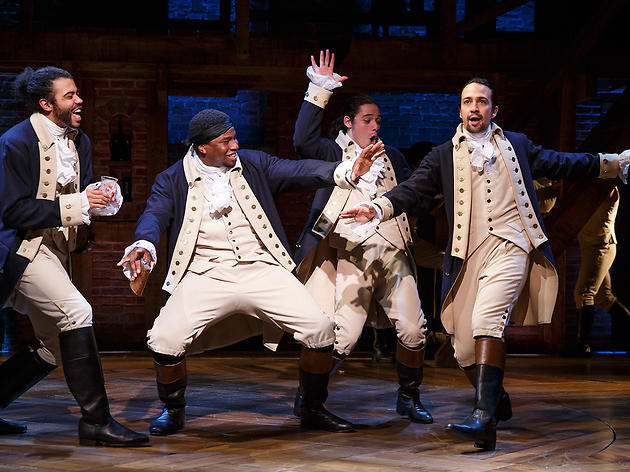
You may have heard of this other musical which uses the racial diversity of its cast to underscore a historical and political point … Photo: Joan Marcus
These choices make worn-out texts feel more interesting, closer to reality, and ultimately better. Rather than rendering performers’ identities and experiences abstract, asking the audience to believe they don’t matter, thoughtful and diverse theatre-making can make race, gender, disability, or sexuality central to the audience’s understanding of an old cultural text, revealing secrets we never knew it was keeping.
Sanditon is one of two novels Jane Austen never finished. Since her death, this fragment of writing has undergone a long journey of alternate interpretations. For better or for worse, everyone who interacts with Sanditon must make their own interpretive choices.
It is a truth universally acknowledged that a Jane Austen fan in possession of six full-length novels must be in want of even more Austen stories.
Luckily for us greedy fans, more writing is available! There are several works of juvenilia as well as unfinished fragments The Watsons and Sanditon. Today I’ll focus on Sanditon, which you can read online. As an unfinished novel, it’s been subject to a lot of interpretation and conjecture over time.
First, Sanditon‘s publishing history: it wasn’t a given that it would be widely shared with readers. Jane Austen was a private person who cared deeply about her work, heavily revising manuscripts before publishing them anonymously. After Austen died, her sister Cassandra safeguarded her writing by destroying some of Jane’s letters and preserving unpublished manuscripts, which were distributed among family members after Cassandra’s death. Austen’s nephew James Edward Austen-Leigh included extracts of Sanditon in A Memoir of Jane Austen in 1871. Some of the Austen family had doubts about publishing Jane’s unfinished works, but Austen-Leigh felt that the public should read them. R.W. Chapman published the full text for the first time in 1925. There are pressing questions here regarding the ethics of publishing posthumously, which is beyond the scope of this post (fortunately, Serena will discuss this topic in an upcoming article!).
A watercolour of Jane Austen painted by her sister Cassandra in 1804. Photo: Wikimedia Commons
Sanditon tells the story of the Parker family and their speculative attempts to make the titular seaside town a resort destination for tourists. The Parkers invite Charlotte Heywood to experience Sanditon’s charms for herself. The sensible, wry Charlotte meets many characters who vary in ridiculousness. Lady Denham, for example, is a rude, tightfisted gentlewoman who delights in having her relatives compete for her favour. There’s also Mr. Parker’s three hypochondriac siblings, who have teeth pulled on the merest suspicion of gum issues, and his charming unmarried brother, Sidney Parker. The stage is set – but the story didn’t have the chance to play out.
Austen started writing Sanditon in the last months of her life, but she was forced to abandon it when she became too ill. The fragment consists of twelve chapters, ending abruptly after Charlotte compares the portraits of Lady Denham’s deceased husbands: one has a “whole-length portrait” over the mantelpiece, while the other gets an inconspicuous miniature. It’s an innocuous moment to end on – but it’s fitting for Austen’s career to end with a witty observation. What little we have of Sanditon is tantalizing, and Austen presents it with characteristic irony and snideness. Sanditon is most intriguing, however, for what we don’t get to see, and for what we must interpret ourselves.
In her introduction to the Penguin edition of Sanditon, Margaret Drabble notes that “one cannot predict with any certainty the ways in which the plot would have developed.” The biggest questions surround the speculative venture; Mr. Parker’s naïvety left me pessimistic about its success. There’s also Sidney Parker to consider – is he another rakish red herring of a love interest like Wickham and Willoughby, a jovial beau like Mr. Tilney, or something else entirely? One interesting character, discussed but not seen, is Miss Lambe, “a young West Indian of large fortune” who is “about seventeen, half mulatto,* chilly and tender” and the “most important and precious” charge of her guardian. Austen novels can be insular, as they focus on the rural English upper-class; Mansfield Park is one exception, as it mentions that the Bertrams acquired their wealth through slave plantations. Sanditon could have been another chance to broaden horizons.
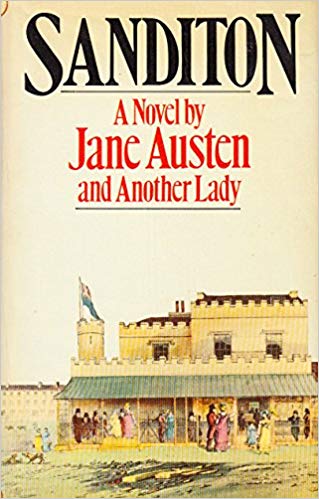
Unsurprisingly, others have tried to finish Sanditon. Some adaptations have questionable literary merits, but the blanks must be filled in. Prominent continuations include Marie Dobbs’s 1975 version and an attempted completion by Austen’s niece Anna Austen Lefroy. There is also an upcoming television series. What choices will it make?
The attribution of Marie Dobbs’s continuation makes reference to how Sense and Sensibility was originally promoted as “A New Novel by a Lady.” Photo: Amazon
We all must guess when it comes to Sanditon. By necessity, reading it is an exercise in making one’s own interpretations. In many respects this is nerve-wracking and unsatisfying. Can our own imaginations match up to Austen’s? Should they? Sanditon, perhaps, can be seen as a gift: a Jane Austen story we can make our own.
*The archaic term “mulatto” refers to people of mixed Black and white heritage and came into use during the period of Trans-Atlantic slavery. Considered offensive to English-speakers today, it is not a word that should be used casually in 2019!
Lego products appeal to children (and adults) of all ages. Now, some advanced sets attempt to capture the look of iconic movie moments, eschewing playability for an “authentic” appearance.
As a child, I devoured the Lego catalogue from the moment it hit my mailbox. Leafing through the pages, I fantasized about adding each set to my collection. Facing the writing prompt “If I were…” in Grade 2 English class, I wrote a short story about being a Lego brick in my own collection – a very meta thought for a seven-year-old, but understandable given how much Lego was on my mind. Every time a new, expensive collection was released, I vowed that I would continue to buy Lego as an adult. Unlike most childhood dreams, oddly, this one came true.
My Lego short story was published as part of Staples’ “If I Were” story collection in 2002. I was pretty thrilled. Photo: Daniel Rose
Since the Lego Company’s famous plastic interlocking bricks were introduced in 1947, the company’s motto of “play well” (or leg godt in the native Danish) has inspired people of all ages to use their imagination to create and to recreate. From movies and books to real places and things, Lego’s sets have used familiar places and themes as a frame for play. Play can take many forms, from the basic level of building the setting and characters to interactive elements (including projectile shooters and complex motors). For the most part, sets are inspired by their subject matter without being overly detailed, encouraging builders to use their imaginations to complete a scenario rather than providing a faithful recreation.
Spurred on by Lego’s official releases, communities of adult fans of Lego (or AFOLs) have created complex constructs based on popular culture, history and even existing Lego sets that attempt to perfectly capture the look of a particular place or thing. Ranging in size and scale (and price!), these designs incorporate minute details – from the shape of a lighting fixture to custom-printing a sticker for a particular section of a wall – to build an authentic-looking creation. Recognizing the unique demands of these consumers, Lego has worked with these “master builders” to offer “advanced” sets that feature greater detail at a higher price range. Whether designed to fit the company’s iconic minifigures or at a more precise scale, these sets appeal to the desire of AFOLs and other builders to have “perfect-looking” recreated spaces while maintaining the tactile building element that has made Lego so popular. Interestingly, these constructs often sacrifice the greater “playability” of Lego in favour of “looking the part”, something which was lampooned in The Lego Movie through the character of The Man Upstairs. Played by an indignant Will Ferrell, the character alleges that the way he uses Lego “makes it an adult thing”, rather than the toy it rightly is. I had never felt more represented, or hilariously caricatured, by a movie before, much to my own amusement.
Model 75192, configured in the classic Empire Strikes Back setup, takes up an entire table in my basement. Photo: Daniel Rose
Nowhere is the desire for accuracy more evident than in Lego model 75192 – the Millennium Falcon. Lego pulled out all the stops for Star Wars fans, who are notoriously fastidious in their demands for accuracy, to create a model that is nearly four feet long and three feet wide. Released in 2017, the model incorporates information from official movie guides as well as the six films the ship makes an appearance in. With 7541 pieces (and retailing for an eye-watering $899.99 – before tax!), it is the largest Lego set commercially produced.* While the set features cross-sections of two of the ship’s classic rooms, allowing builders to use the eight included minifigures to act out scenes from the movies, more attention is paid to minute design elements. Builders can swap out parts, such as the ship’s radar dish, depending on their preference for the original trilogy or the sequel trilogy. The set is the zenith of “authentic” official releases, demonstrating the extreme lengths builders can go to reproduce space.
The scale of the model is gobsmacking – each of the six “vents” has the same circumference as my fist. Photo: Daniel Rose
Model 75192 reveals the absurdity of the pursuit of authenticity. It replaced Model 10179, released in 2007 with a paltry 5 195 pieces (and 5 minifigures) in comparison. The intervening decade saw Lego design new parts and Disney release new Star Wars films; that is to say, that which was authentic previously is no longer a perfect recreation today. The same goes for unofficial constructions – the introduction of new design elements can make what was a faithful interpretation of a place or thing into an outdated caricature. This speaks to the importance of the imagination in filling the gaps better than an interlocking brick. Each recreation embodies the spirit of what the builder considers an essential part of the design. Even if the results never quite measure up, the pursuit of perfection is revealing.
Author’s
Note: In the interest of clarity, I would like to note that I was one of the
folks who purchased Model 75192, much to the chagrin of my savings and my
common sense.













 The Mindful Rambler