Some school boards won’t teach cursive writing anymore. The impact of this decision bears heavily on the ability to write and read handwritten documents, with possible implications for historical interpretation.
In our increasingly digital age, what will become of handwriting?
I’ve always found it fascinating to see people’s handwriting, and I associate the way they write with their personality, almost. At least, it’s a part of their identity. Being able to recognize people’s handwriting is also useful when you’re trying to tell who wrote something (it’s always interesting that Santa seems to have the same penmanship as Mum or Dad…).
Photo: Michal Jarmoluk
Yet, with the domination of smartphones and laptops, we don’t have to hand-write notes or messages as often as before. As a lover of the written word, and a typography nerd, I feel a bit wistful reflecting on the disappearance of paper and pen.
One thing that strikes me is the choice of some school boards to cease teaching cursive writing to children. It’s something that’s happened in my own province of Ontario – kids are no longer going to learn cursive penmanship, meaning that they will have to resort to printing, in the case that they do write.
I myself write an approximation between printing and cursive writing, wherein I drag my pen to connect the letters (it’s much easier and quicker than printing, but it’s not by-the-book cursive). However, I know how to read cursive writing – but will the people of the future?
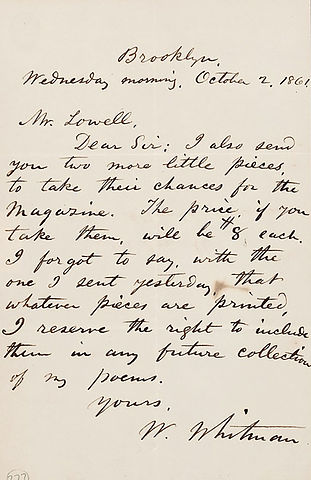
Take this letter from American poet Walt Whitman, for instance. We can probably decipher the text, as Whitman’s scrawl is fairly legible compared to countless other cursive letters, but we’ve also learned in school how to recognize the script (the letter “Q” in cursive always looked like a silly “2”, or a swan, but we get taught to recognize it – something our children won’t receive).
It’s difficult to say whether people who haven’t been taught cursive writing will be able to read letters like these. Whitman’s hand is one thing, but how about those who wrote much more sloppily in the past, or with a much steeper slant?
“Woman Writing a Letter with her Maid”, Johannes Vermeer. Photo: Wikimedia Commons
Not too long ago, I was at the Thomas Fisher Rare Book Library at the University of Toronto, where I completed my master’s degree. I spent a few days reading through the correspondence of General James Wolfe, the leader of the victorious British forces at the fabled Battle of the Plains of Abraham (1763) which defined the colonial future of Quebec and ultimately Canada. Wolfe’s writing was quite elegant, but I often had trouble deciphering some of his words (I’d like to illustrate my point, but the original copies of his letters are protected in the library, so I don’t have photographs).
Letters like these, and early manuscripts, are extremely important documents to study, both in a literary and historical sense. In the humanities, we’re working with written documents all the time, and being able to read as much as we can is a necessity. Even just for leisure, being able to write and read cursive is a special and worthwhile skill. It’ll be interesting to see how reading evolves in the future when most of the documents we produce will be typed.
It’s a little ironic: I almost wish I could have handwritten this post for effect.
I didn’t come up with the title for this post myself – it’s a slogan coined by Dine Alone Records, the Canadian independent record label based here in Toronto.
We can take some pointers from its message, as Canadian art is often dismissed – from literature, to visual arts, to music, and more. It’d be interesting to see what percentage of music in our libraries is Canadian – I’d wager most Canadians have 15% or less. But the fact is that there is so much Canadian music out there – and it’s good.
Canadian Indigenous singer-songwriter Buffy Sainte-Marie. Photo: Flickr
What is it about being Canadian that automatically garners less attention? We even have poorer-quality versions of American reality TV shows, and a terrible Netflix selection compared to our southern neighbours to show for it.
In our current political climate, feat. a tariff war with the United States (which, let’s be honest, flares up every so often like a chronic wound), why not support Canadian musicians and invest in some local talent?
Here are some concise, but by no means comprehensive, top picks for quintessential Canadian listening. Enjoy my quick recs below.
A Tribe Called Red: Essential Indigenous electronic/hip-hop; mandatory listening. Songs to Start With: “R.E.D.,” “How I Feel”, “Bread & Cheese”
Billy Talent: Political commentary & punk rock all in one. Crisp guitars; crisper lyrics. Songs to Start With: “Try Honesty”, “Devil in a Midnight Mass”, “White Sparrows”
July Talk: Jarring juxtaposition of vocals – guttural/masculine vs. soft/feminine. Songs to Start With: “Headsick”, “Blood + Honey”, “Picturing Love”
Alexisonfire: “The sound of two Catholic high-school girls mid-knife-fight”.* Songs to Start With: “Boiled Frogs”, “Get Fighted”, “Midnight Regulations”
*I can’t describe it any better than they already have…
City and Colour: Mournful lamentations nursed by Dallas Green’s voice. Songs to Start With: “Casey’s Song”, “Waiting…”, “The Lonely Life”
Arkells: Anthemic, buoyant daytime rock with a touch of motown. Songs to Start With: “Where U Goin”, “Cynical Bastards”, “John Lennon”
Mike DeAngelis and Max Kerman of Hamilton band Arkells, at WayHome Music and Arts Festival 2016. Photo: Flickr
Death From Above: Industrious duo at the junction of bass & drums. Songs to Start With: “All I C is U and Me”, “Crystal Ball”, “Romantic Rights”
Tanya Tagaq: Daring, innovative, and traditional Inuit throat-singing. Songs to Start With: “Uja”, “Sila”, “Retribution”
Mother Mother: Three-layered high-pitched vocals on a base of synth and strings. Songs to Start With: “Ghosting”, “The Stand”, “Infinitesimal”
Sum 41: Sprawling spitfire of classic punk rock with heavyweight choruses. Songs to Start With: “Still Waiting”, “Open Your Eyes”, “With Me”
USS (Ubiquitous Synergy Seeker): Lucid, lively electronica fuelled by lyrical emotion. Songs to Start With: “Damini”, “Vulcan”, “Freakquency”
Arcade Fire: A convergence of 6+ hipsters producing indie rock with accordion and keyboard at the fore. Songs to Start With: “Ready to Start”, “The Suburbs”, “No Cars Go”
Monster Truck: 70s style blues rock backed by organs. Long hair & denim required. Songs to Start With: “Don’t Tell Me How to Live”, “Old Train”, “For the People”
Hollerado: Personable indie rock with a genuine sound and hard-hitting beats. Songs to Start With: “Too Much to Handle”, “So It Goes”, “Got to Lose”
Drake: No description needed for Toronto’s resident rapper… Songs to Start With: “Passionfruit”, “Over”, “God’s Plan”
Our Lady Peace: Low, crooning vocals replete with reassuring lyrics. Songs to Start With: “Innocent”, “All You Did Was Save My Life”, “Angels/Losing/Sleep”
Avril Lavigne: Do I even need to explain this? Songs to Start With: “Complicated”, “Sk8er Boi”, “I’m With You”
Cancer Bats: Gritty underground metal; shredding, cymbal-smashing oblivion. Songs to Start With: “Hail Destroyer”, “Beelzebub”, “Gatekeeper”
Three Days Grace: Bass-heavy garage-rock with brutally honest insights. Songs to Start With: “Just Like You”, “Never Too Late”, “Last to Know”
Sam Roberts Band: Even-paced alternative rock with laid-back guitars. Songs to Start With: “Brother Down”, “Them Kids”, “If You Want It”
Half Moon Run: Serene assertions on the human condition, featuring folksy acoustics. Songs to Start With: “Nerve”, “Trust”, “Narrow Margins”
Wintersleep: Guitars, synth, and experimental riffs with a sprightly rhythm. Songs to Start With: “Lifting Cure”, “Metropolis”, “Santa Fe”
Of course, there are also the Canadian classics, which you might consider revisiting for the long weekend. I’ve created a track-by-track vignette of essential Canadiana:
Rush – “YYZ”
Buffy Sainte-Marie – “Working for the Government”
Bryan Adams – “Summer of ’69”
The Guess Who – “American Woman”
Gordon Lightfoot – “Canadian Railroad Trilogy”
Shania Twain – “Man! I Feel Like A Woman”
Alanis Morissette – “Thank U”
Sarah McLachlan – “Building A Mystery”
Great Big Sea – “The Chemical Worker’s Song”
Neil Young – “Heart of Gold”
Joni Mitchell – “Big Yellow Taxi”
Leonard Cohen – “Treaty”
k.d. lang – “Constant Craving”
Celine Dion – “My Heart Will Go On”
Barenaked Ladies – “Canada Dry”
The Tragically Hip – “Bobcaygeon”
Obviously I omitted a bunch of bands/artists, mainly because I don’t listen to them enough to consider myself worthy of making thoughtful recommendations. Other Canadian artists are included below.
Shad, Lights, The Dirty Nil, Anne Murray, The Jerry Cans, Shawn Mendes, Sloan, Tegan and Sara, Michael Buble, Metric, Simple Plan, Young Empires, Joni Mitchell, Nelly Furtado, Bruce Cockburn, Jann Arden, The Trews, Corey Hart, Alessia Cara, Ron Sexsmith, Diana Krall, Stan Rogers, BROS, Feist, The Beaches, Moneen, The Darcys, The Weeknd, Justin Bieber, Said the Whale, Constantines, Marianas Trench, Silverstein, Broken Social Scene, Big Wreck, Nickelback, PUP, Dear Rouge, Blue Rodeo, Hedley, Fucked Up, Toronto, Great Lake Swimmers, The Rural Alberta Advantage, Teenage Head, Down With Webster, Thousand Foot Krutch, Matt Good Band, The Tea Party, The Sheepdogs, Hey Rosetta!, The Elwins, IllScarlett, Prism, I Mother Earth, Black Lungs, Chromeo, Japandroids, Whitehorse, Protest the Hero, The New Pornographers, Joel Plaskett, Northern Voice, Serena Ryder, Lost Cousins, Moist, Neverending White Lights, Platinum Blonde, Stabilo, Saint Asonia, Finger Eleven, Templar, Theory of a Deadman, Wolf Parade, Yukon Blonde, Born Ruffians, Black Bear.
Over the years, so much of Canadian identity has been built on what we’re not (namely, American). Let’s talk about what we are, for a change. It’s something Canadian music does well, if we only listen.
walk for pleasure, typically without a definite route.
talk or write at length, typically in a confused or inconsequential way.
Hi! My name is Serena, and I’m the Founder and Editor-in-Chief of The Mindful Rambler. I started this blog to explore questions of interpretation and the ways we communicate in the public sphere. As the definitions above suggest, there will be confusing moments during these “rambles” when we don’t know exactly where we’re going – but they’ll help us learn! To celebrate our official launch, I’d like to introduce you to one of our four key themes: History.
History is all around us, with new additions embracing (or sometimes overpowering) the old. Photo: Serena Ypelaar
History is all around us. The present is influenced by our past and the way we remember it. History isn’t just “the past”, though – it’s not as objective as that. Rather, history represents the way we interpret and understand the past using material evidence.
Such evidence can come in the form of documents, photographs, artwork, audio, or even commonplace objects. We construct history from this evidence; it’s not always easy to process or understand, especially when we’re trying to synthesize multiple (sometimes conflicting) pieces of evidence into a coherent story.
What types of evidence are privileged? Which voices do we value? In placing emphasis on some forms of evidence over others, which perspectives do we identify as “more important” in the greater scheme of things?
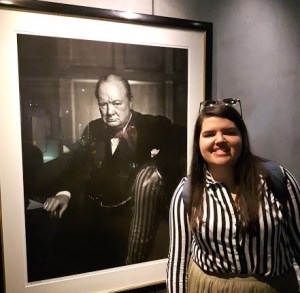
Serena stands with Yousuf Karsh’s 1941 portrait of Sir Winston Churchill at the Churchill War Rooms, London, UK. We can interpret photographs like this one as historical evidence of a period in time. Photo: Serena Ypelaar
In this column, “On History“, we’ll delve deeper into these questions using specific case studies. It’s crucial to understand how we remember our past and why we remember it that way. By consciously exploring our interpretative processes, we can understand the methods we use to create bridges between the past, present, and future.
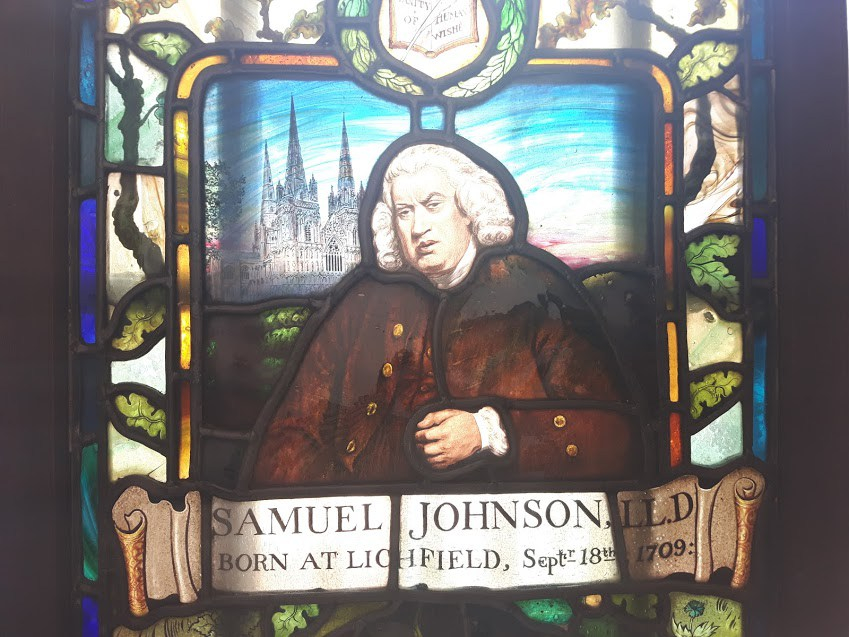
The name “The Mindful Rambler” is a tribute to Dr. Samuel Johnson, the 18th century scholar and writer of the first English Dictionary. Published between 1750 and 1752, Johnson’s periodical The Rambler discussed contemporary societal issues such as politics, religion, morality, and literature. In coming up with a title for this blog, I enjoyed the idea of “rambling” like Dr. Johnson, but the connotations seemed a little more lackadaisical than the goal of this blog – hence the addition of mindfulness to our title.
Stained glass window commemorating Samuel Johnson’s life, located at Dr. Johnson’s House Museum in Gough Square, London, UK. Photo: Serena Ypelaar
We should definitely let our ideas unfold so we can learn new things from one another, but being mindful of how we interpret and communicate will ensure the ethical sharing of knowledge. Johnson had similar beliefs:
Integrity without knowledge is weak and useless, and knowledge without integrity is dangerous and dreadful. — Samuel Johnson
From reflecting on lessons learned, to contemplating ongoing mysteries, to questioning privileged knowledge structures, we owe it to our future to acknowledge and preserve our past – and to inform how we treat history going forward. It’s my hope that when considering issues of interpretation and communication, we always tread mindfully – and think before we ramble.






 The Mindful Rambler