Skeletons in the Closet

Although we might prefer to keep our private lives secret, they constitute an important part of the historical record.

By Lilia Lockwood

One fine day in 1881, in a quiet New Zealand town, a former Methodist minister left his home and family, boarded a ship, and disappeared. That man was my great-great-grandfather, and his fate remained a lingering mystery for several decades. His story is one I have been thinking about as I work on recording our family history – not so much what happened to him, but how his story should be told and who has the right to tell it.

Historians face many ethical questions when writing biographies, and in this blog post I’d like to consider the following one: do individuals have a right to dictate which parts of their life are private even after they are gone? Serena explored how we can create and curate our own image while we are living. But what happens when we have died? Do we get to take our secrets to the grave? Or, once we are buried, do the skeletons in the closet get unearthed?
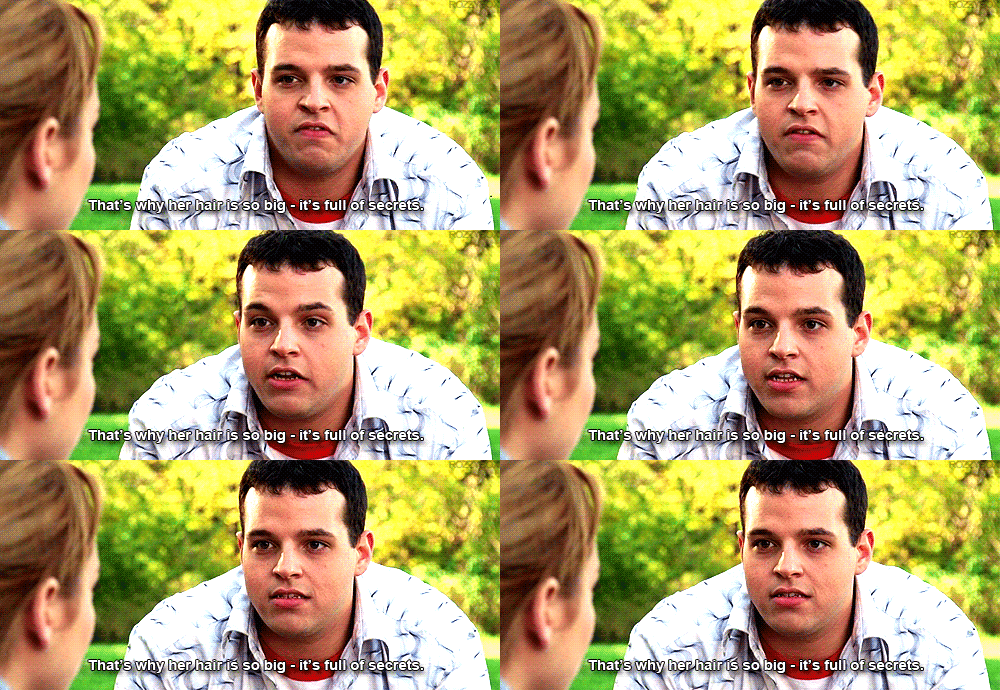
giphy
Big hair isn’t worth all the secrets that will come to light when you’re gone. Photo: Giphy

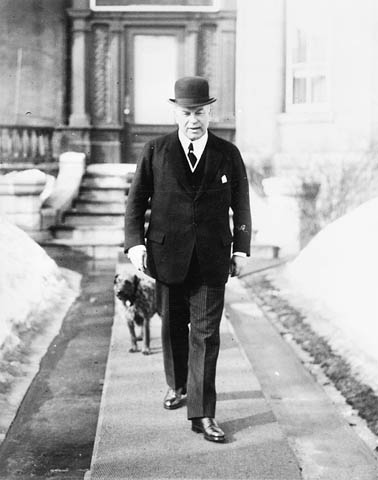
The quintessential example of this in Canadian history is Prime Minister William Lyon Mackenzie King and his personal diary. King died in 1950, leaving behind a diary that he had written in daily for decades. He directed the executors of his will to “destroy all of my diaries except those parts which I have indicated are and shall be available for publication or use.” King had intended for the parts of his diaries that concerned public affairs to be used by biographers, and for the rest to remain private. But the problem was that he did not specify these sections before his death.
c009059
King accompanied by his beloved dog Pat, who is mentioned in King’s diaries. Photo: Nagel / Library and Archives Canada / C-009059.

On the one hand, we have King’s desire for privacy. On the other hand, we have an exceptionally rich historical resource that documents how, as Canada’s longest serving prime minister, he steered the country through the Roaring Twenties, part of the Great Depression, and the Second World War. The diaries provide an intimate glimpse into his personal and public life, and a valuable insight into Canadian social and political life.

Ultimately, the executors decided to preserve the complete diary. Not only that, the volumes were made publicly accessible in their entirety. They are available online through Library and Archives Canada (and are even word searchable!).

Countless historians have relied on these documents for their research on Canadian history, expanding the scholarship in this field. That is why it is essential to preserve the most complete historical record possible. There is no denying that the more colourful aspects of King’s character are revealed in his diaries; he is now perhaps as recognizable for his belief in the supernatural as for his political career. But rather than overshadowing his achievements, the diaries provide us with a more complete understanding of King and country.

The Pain of Nostalgia

Nostalgia hurts us. Reliving past joys causes us pain, but why? And why does this nostalgia translate to media we enjoyed at a different time in our lives?

By Serena Ypelaar

Have you ever felt inclined to revel in the past but found that it just hurt too much?

Last night, The Wizard of Oz (1939) was on TV and I felt instinctively drawn to it. Why? Because The Wizard of Oz was my favourite film as a kid, from when I was about three or four. It’ll always have very strong sentimental value and I’ll always feel quite attached to it. It’s also an excellent film for its time, a cinematic masterpiece that makes a big impact even now.

But when I tried to watch the film yesterday (admittedly after a very long and trying day), I almost physically couldn’t handle it. Instantly, I found myself on the verge of tears, regardless of what was happening in the story at any given time. (For the record, it was the part in which the Scarecrow (Ray Bolger), Tin Man (Jack Haley), and Cowardly Lion (Bert Lahr) infiltrate the witch’s fortress trying to rescue Dorothy (Judy Garland). Dorothy was calling for her Auntie Em in the crystal ball as the hourglass trickled down, and I was done for.) I felt that familiar clenching in my chest that strikes when I feel intense nostalgia (or interestingly, when I feel anxious). But this pain seems the most potent when I’m thinking about good days gone by, and how far removed I am from them now.

oz
The Wizard of Oz (1939). Photo: Flickr

My childhood is a safe haven which in times of difficulty I sometimes crave. While I won’t be short-sighted enough to assume this is the case for everyone, I want to examine nostalgia as a common element of the human experience, whether it’s for one’s childhood or a different time in one’s life.

Why couldn’t I watch the film without experiencing physical and emotional pain? Because nostalgia is so powerful that we feel victim to it, and any past emotions we felt are felt again – this time accompanied by loss. We’re not in that moment anymore and we can never be again. We’ve learned in The Great Gatsby (1925) that “you can’t repeat the past”, and trying to recreate it can cause intense suffering. But nostalgia gives us so much deeply rooted longing that we’re often gripped by it unexpectedly.

One of my favourite TV series, Mad Men, uses the concept of nostalgia to great advantage in the final episode of its first season. When Don Draper makes an advertising pitch for the newly patented Kodak carousel slide projector, he delivers a presentation so moving that one of his colleagues runs from the room in tears.

Nostalgia – it’s delicate, but potent. Teddy told me that in Greek, “nostalgia” literally means “the pain from an old wound.” It’s a twinge in your heart far more powerful than memory alone … it takes us to a place where we ache to go again.

Mad Men 1.13, “The Wheel” (2007)

Knowing that nostalgia is supposed to hurt may not mitigate our tumultuous experience, but it can offer some shared comfort as we all navigate the inevitable passage of time.

The question is, do we choose to brave the pain and relive our wonderful memories, or do we stuff them away to avoid the emotional turmoil? The second option is arguably worse for emotional health in the long run – though it’s admittedly hard to look back on a golden age from a new and learned perspective.

But then again, aren’t our good memories worth it?

At the Movies, Music is the New Sports

The recent proliferation of superhero movies leaves us with specific associations regarding blockbusters. Sports films had their heyday in the 1990s, but does the imminent release of Bohemian Rhapsody and Rocketman signal a resurgence of music biopics?

By Serena Ypelaar

Is there a sports team that everybody likes? No way.

Are there bands/musicians that (nearly) everybody likes? I think so!

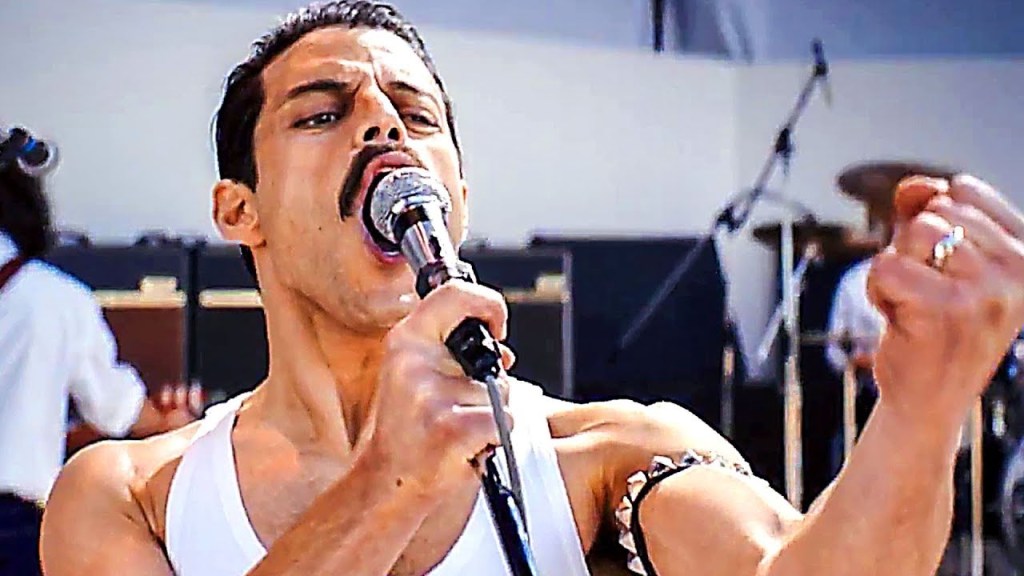
Why am I asking these questions? Mainly to posit a recent theory of mine that music biopics are the future of the film industry. The upcoming release of movies like Bohemian Rhapsody (2018), in which Rami Malek plays Freddie Mercury of the rock band Queen, and Rocketman (2019), starring Taron Egerton as Elton John, got me thinking about the marketability of popular cinema genres these days.

ramimalek
Rami Malek as Queen frontman Freddie Mercury in Bohemian Rhapsody (2018). Photo: YouTube

Ever since the Harry Potter films were finished (which in my completely unbiased opinion set the standard for franchise/adaptation blockbusters), I’ve felt like there haven’t been as many blockbusters that don’t wear thin. The creative industry of Hollywood seems increasingly stale with its endless superhero reboots. I feel sorry for the dead horse that is the Marvel franchise – it’s taken so many beatings over the last few years (Infinity War is aptly named). Just when you think nobody wants another superhero flick, people still flock to the theatres without fail.

taron
Taron Egerton as Elton John in Rocketman (2019). Photo: IMDb

Marvel keeps making the movies because people keep watching. Movies are creative, but they also have to sell, which is where formulas come in. With the ever-pressing need to make more high-grossing films, it looks like we might be in for an oncoming surge in music biopics.

Why do I think music flicks are so universally marketable compared to, say, sports? Well, for starters, I know from experience that sports are highly emotional, and at times, controversial.

  1. Not everyone likes sports. Nearly everyone likes music of some kind (correct me if I’m wrong).
  2. Of those who do like sports, they have a team/athlete they love, and teams/athletes they HATE. Just look around during the World Cup or the NHL – people are at each other’s throats over sports teams.
  3. The competitive nature of sports (win/draw/lose) is much different than the non-discrete, creative nature of music – it’s possible to like many genres without needing to “beat” others (award shows aside).
endofrelationship
Sports disagreements can loom large; there’s a deep sense of loyalty to one’s team that doesn’t hold as much emotional tension in music preferences. Unless you are Nickelback. Photo: Gifer

Maybe my evidence is anecdotal, but there’s a certain type of community that comes from music. There are songs that seem exempt from hatred, and it’s this phenomenon that I think makes music flicks much more viable than sport flicks. Not that there can’t be good sport films, but in terms of mass marketing, making a film about a timeless and popular band has a higher chance of box office success than a movie about a given sport, team, or athlete who has a smaller group of fans.

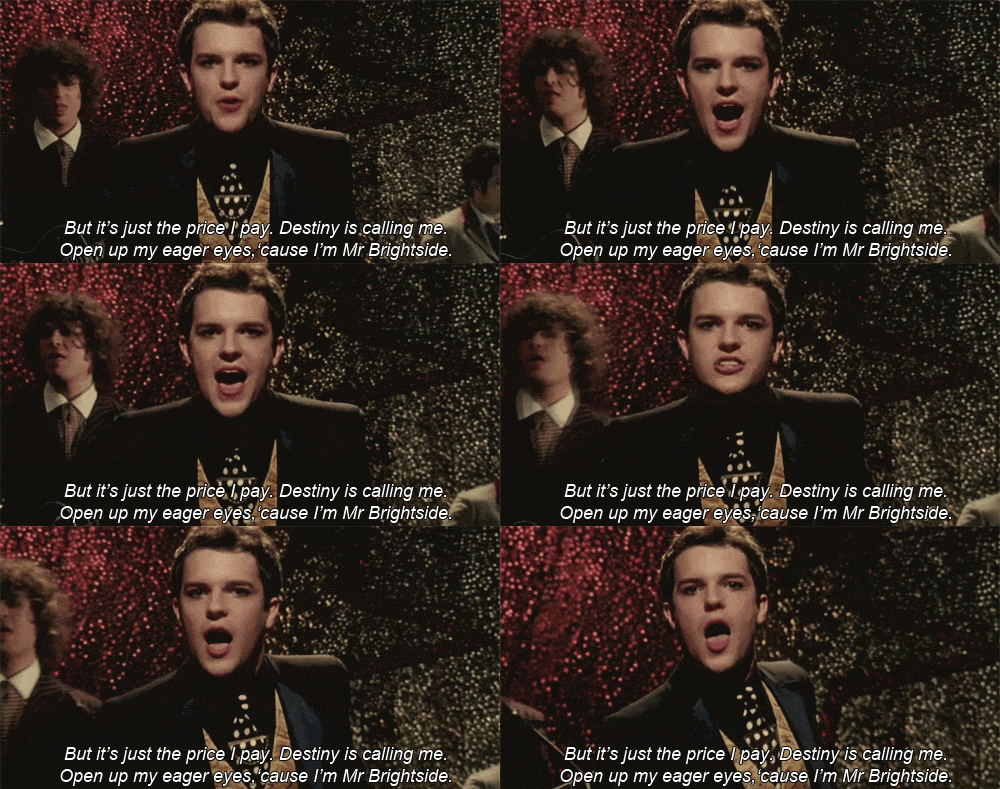
For instance: one of the most timeless songs of the twenty-first century so far is The Killers’ “Mr. Brightside”. I’d be hard-pressed to find a single person in my generation who couldn’t/wouldn’t belt out the lyrics at a moment’s notice (COMIN’ OUT OF MY CAGE AND I’VE BEEN DOING JUST FINE) upon hearing the opening chords. I wholeheartedly expect a Killers biopic in thirty years’ time titled Mr. Brightside, because what better way to bring in the masses than by using a tune that’s instantly recognizable and which personifies the band itself?

killers
Swimming through sick lullabies, choking on your alibis… Photo: WeHeartIt

It certainly seems to be the strategy that the teams behind Bohemian Rhapsody and Rocketman have employed. Based on the widespread popularity of both these musical acts, I almost wonder if the storyline even needs to be stellar, as long as the cast puts on a good show musically (just ask Mamma Mia!). The film industry is under pressure to deliver some fresh takes, but that doesn’t mean it won’t draw upon timeless old classics in a new light. After all, classics are guaranteed popularity.

Perhaps, based on the success of Bohemian Rhapsody and Rocketman, music flicks will take off – I certainly wouldn’t mind. May they pack a more satisfying punch than the exhausted superheroes can muster.

Self-Fashioning and the Autobiography

The autobiography is a curious means of presenting one’s life story, one that allows for filtration and condensation into a story as engaging as the author (the self-biographer) desires. 

By Serena Ypelaar 

Lately, I’ve been thinking a lot about autobiographies, in which someone illustrates their own life by selectively exploring episodes of their past. There’s a certain kind of autonomy in fashioning one’s own life story for public consumption, in which we can filter out certain aspects like a sieve. Maybe we don’t want unflattering elements of our lives to reach the eyes and ears of others – but would that be as compelling a story?

If we don’t admit our failures, conflict, setbacks, surprises, embarrassments, and other negative experiences, what shadow of ourselves are we presenting? The phenomenon of “self-fashioning” is all the more relevant to us in the twenty-first century, since Instagram and other social media rule the day. Our Instagram pages are curated galleries of our identity, but they’re only the tip of the iceberg, an infinitesimal slice of our actual lives. They nevertheless create an impression that lasts, especially when we don’t often see someone in person. Short of communicating with them directly, we’re left with what they present to us on social media, a public front that one can’t call balanced. This controlled presentation is like a darkened room that only allows light through tiny cracks – the cracks being the posts we decide to share.

24516640148_5811a2514f_k
Author Sophie Kinsella writes authentic protagonists who own their mistakes and suffer embarrassing moments like all of us. Photo: Niklas Maupoix

British novelist Sophie Kinsella recently released a book titled My Not So Perfect Life (2017) which focused on the warped perceptions of our lives and others’ thanks to social media. Kinsella has encouraged readers to share less-than-perfect moments of their lives on Instagram and to celebrate them as a typical facet of the human experience. But the persistent insincerity of Instagram mirrors the ability of formal autobiographies to stretch, filter, and warp the truth. When publishing on social media, we’re sharing only the parts of ourselves that we want the world to see.

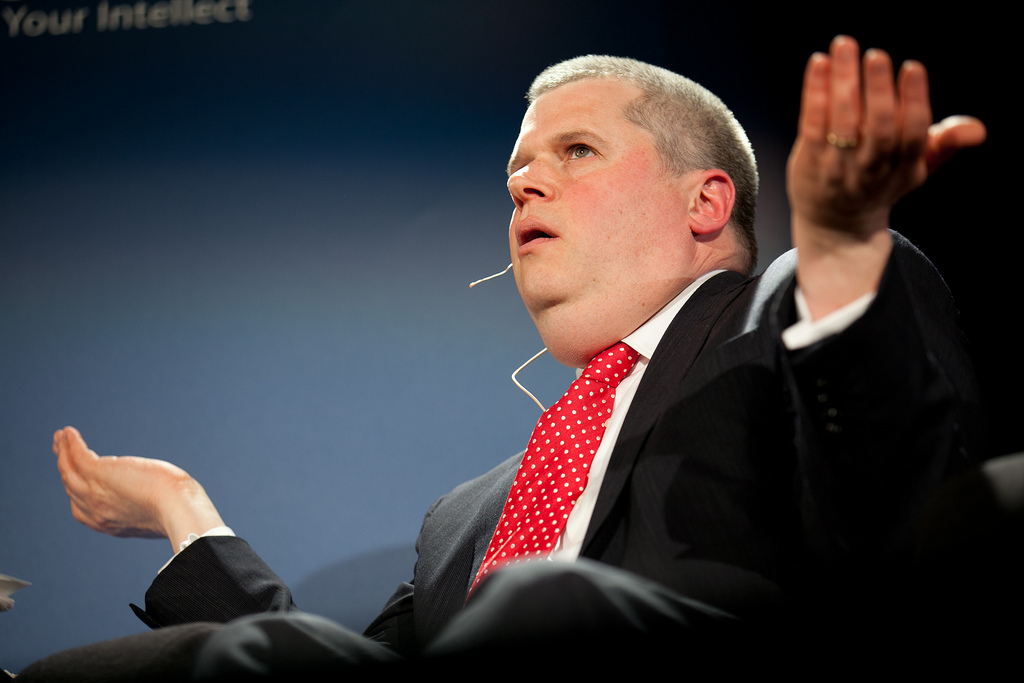
Lemony Snicket provides another, albeit exaggerated view into self-fashioning: his Unauthorized Autobiography (2002) is a dramatized example of how the autobiography is a tool of self-invention. Lemony Snicket is in fact a fictitious character (created by American author Daniel Handler) credited with chronicling the lives of the also fictional Baudelaire orphans. Likewise, Snicket’s autobiography represents the lengths that we can go to in order to construct and manipulate identity on a public platform.

handler
Author Daniel Handler, who also writes under the pseudonym “Lemony Snicket”, created the Unauthorized Autobiography to compile selected information about his fictitious alter ego. Photo: JD Lasica

Whether or not we’re actually writing a formal autobiography, we are authoring our identity every day, inventing our public face based on how we act and what we share. When documenting that identity, we can and should carry an awareness of how we will be perceived by others not only today, but in the future. In the practice of history, for instance, we try to understand people who have predeceased us based on records left behind; it’ll henceforth be interesting to see how historical analysis proceeds in the digital age.

The true self, the one we are when we are alone, only has one audience member: ourselves. Our true identity is beyond communicating with others because there are so many layers to such an identity; so we’re burdened with the responsibility of choosing how we present it to the world. The question is, will we favour authenticity or will we compete on the basis of concealing our very human flaws?

How Does History (Literally) Speak to You?

One thing we can’t glean from history prior to the invention of the phonograph is how people’s voices sounded. We may feel a profound connection with historical figures but can never hear how they spoke, a key aspect of their identity and personality. 

By Serena Ypelaar 

Historical figures are more than just pictures on a page. They are people who lived and contributed to their communities, and trying to imagine them doing so can be a challenge to historians depending on what evidence remains. We’re always searching for more insight into the key quality that truly brings a historical figures to life: their personality.

Just as we once had no photographs to see what people really looked like, so too did we once lack film evidence that people really lived and spoke in distinctive ways. In trying to get a sense of mannerisms and voice, we first had to rely on audio.

Why do I think voice is such an important aspect of connecting to those who have predeceased us? I’m going to use politicians as my prime example. Many politicians are remembered as great orators whose speeches have moved and influenced societies during major events, from celebrations to declarations of war. I believe our voices carry much emotion, therefore conveying an important aspect of who we are.

lutherking
Martin Luther King Jr. addressing crowds in Washington, DC. Photo: National Park Service

Think about it: how many times have you seen/met someone, and at first glance expected them to have a specific kind of voice (low, high, quavery, strong, accented)? And then they open their mouths and a completely different voice comes out! It changes your impression of them, doesn’t it? For instance, Daniel Day Lewis speaks in a higher pitch in the film Lincoln (2012), illustrating the surprising truth about former American President Abraham Lincoln’s high, reedy voice. It just goes to show how much the quality of one’s voice defines their presence.

Voices can be commanding or meek; soft or loud; rough or smooth; and all these sensory elements shape and cement identity, especially in public memory.

Take King George VI of Great Britain, and his speech of 3 September 1939 in which he confirms Britain’s involvement in World War II. This is the very same speech featured in the 2010 film The King’s Speech, as played by Colin Firth – and we can gain such a significant connection when hearing the King’s voice that it’s as if he’s in the room with us (such was the initial reaction to radio). If you listen to the real speech, you can hear George VI’s inflection and get a better impression of his presence, breaking an interpretation barrier that keeps him (and likewise, other historical figures) at a distance from us today.

Would Martin Luther King Jr.’s “I Have A Dream” speech (28 August 1963) be as rousing if we had read it on paper? Dr. King’s delivery of the speech is often remembered as an iconic capstone of the Civil Rights Movement, demonstrating the significance of voice and audio in preserving historical records. Similarly, former British Prime Minister Sir Winston Churchill’s characteristic drone is recognizable to many of us, and his famous WWII “We Shall Fight on the Beaches” speech (4 June 1940) has also been recreated in recent films such as Dunkirk (2017) and Darkest Hour (2017).

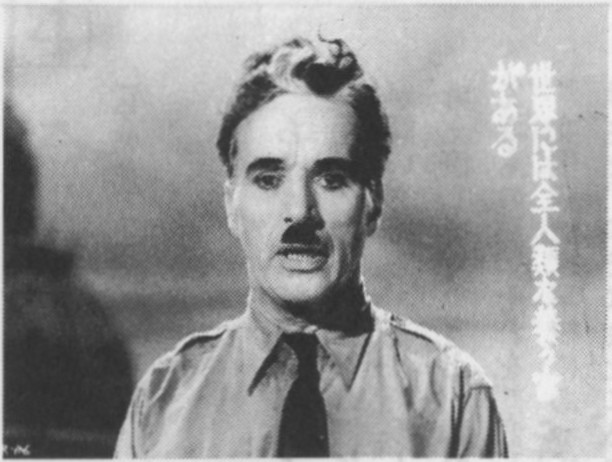
Charlie Chaplin, a British actor who was primarily known for his silent films, also understood the power of speech and voice in captivating and inspiring audiences. Taking advantage of the emergence of sound in film, his speech in The Great Dictator (1940) subverts Adolf Hitler’s acknowledged oratory skills and uses them for good in his own parody version of a wartime dictator’s speech.

dictator
Charlie Chaplin in The Great Dictator (1940). Photo: Wikimedia Commons

Still further, accents offer a whole different opportunity for biographical interpretation: for example, though former Canadian Prime Minister Sir Wilfrid Laurier was a Quebecois francophone, he learned English in New Glasgow and therefore spoke with a slight Scottish accent, something I could never learn from merely looking at photographs or silent film clips. Observations were written down, but without audio we can never hear them for ourselves. The first Canadian Prime Minister Sir John A. Macdonald’s accent is also in question, as he was raised in the Bay of Quinte/Kingston, Ontario, far from Glasgow itself (though the latter was his birthplace). American President John F. Kennedy’s Boston accent also defines his aura in our memories. If we can hear politicians speak, we can further understand their essence as people and their leadership qualities.

Is this post, then, a prolonged lamentation that I’ll never get to hear the voices of so many historical figures who captivate me? I’m not denying it – and I’m arguing that we could all do with taking some time away from our highly absorbing smartphones to be present. Listen to people’s voices, enjoy the timbre and cadence, connect with the emotions that shine through when people speak. We often take it for granted that we’ll get to hear their voices every day, but when they’re gone, all that will be left of them is our memory and the records we’ve kept.

Monument Men: Constructing Likenesses

Creating commemorative likenesses – statues, wax figures, paintings – is no easy feat. The way an individual is remembered could have repercussions for years to come, so how does creativity factor in?

By Serena Ypelaar

When we visit a wax museum, we’re usually prepared for a couple of duds that look nothing like they’re supposed to. Perhaps it’s due to the levity of such a space – after all, what purpose do wax museums serve apart from the fleeting amusement of seeing celebrities’ likenesses up close?

However, with commemorative likenesses such as statues, busts, or paintings meant to immortalize public figures, there’s a lot more to it. A grossly inaccurate portrayal could be damaging to a person’s public image, and depending on the nature of the commemoration, may be seen as unflattering or even disrespectful.

Take footballer Cristiano Ronaldo’s infamous bust, which was unveiled at Madeira Airport in Portugal last year. The bust was mercilessly ridiculed and made the subject of numerous memes, to the point that the artist had to redo it.

ronaldo
Portuguese footballer Cristiano Ronaldo was commemorated with this bust by sculptor Emanuel Santos in 2017. Public opinion ensured that it was replaced by a new, “more accurate” version, which can be seen below. Photo: Know Your Meme

Admittedly, famous individuals like these are exposed to these depictions by the very nature of their existence – they’re well-known, so people are going to make fun of them, whether it’s creating unflattering portrayals or vocally enjoying such parodies. That doesn’t make it right or excusable, especially if the public figure is a good person (if they aren’t, well, have at it!). Nevertheless, the fact remains that famous people lose the ability to regulate their public perception. The same goes for unauthorized biographies and the like – there isn’t much that can be done to prevent these interpretations unless someone wants to sue for libel.

standard
Photo: Bleacher Report

The new, sleek Ronaldo statue reflects what we’re conditioned to expect when it comes to commemorative statues, though – a public monument is no hokey wax figure. We seem to expect accuracy and a display of strength or nobility in these types of depictions, which is why more gutsy interpretations often get shot down. Yet we can’t pull the plug on artists’ interpretations altogether. To do so would be to rob artists of their style and create a mild form of censorship that could inhibit creative thinking. (Whether we want to foster “creativity” when it comes to portraying likenesses for public commemoration is another question altogether).

Still, that won’t stop me from expressing my dislike for what I call the “Paper Airplane Portrayal” of Canada’s longest-serving Prime Minister, William Lyon Mackenzie King. Cristiano Ronaldo is one thing – as an athlete, he doesn’t carry the same kind of significance that a former national leader might. So King’s statue on Parliament Hill in Ottawa seems even more bizarre to me, since I would expect him to look a bit less cartoony and more like the other statues on the Hill. Sculptor Raoul Hunter was aiming to convey King’s forcefulness as a leader, according to this page on the Government of Canada website explaining the interpretations of the statues. The other monuments on the Hill portray their subjects more proportionately, whereas King can only be described as abstract. His monument makes me laugh at him a little, which, applied in the context of public office, is surely a less desirable outcome.

king
You don’t need a picture of King to know that nobody is shaped so angularly. Nor did King’s head appear so oblong in life. I will add, however, that this statue was created in 1967 when this style was in vogue, which could raise another fascinating discussion about how aesthetic standards affect portrayals during a given era. Photo: Flickr

Of course, I’m sure it’s all a matter of personal opinion – I know people who like the King statue (above). And that 81-year-old Spanish lady who famously “touched up” Jesus’ face in the “Ecce Homo” fresco clearly thought his makeover looked fine…

Irrespective of whether we can gauge the accuracy of monuments beyond personal preference, discussing the issue tells us what we value as a society on a surface level. Commemorative monuments rely on context and setting to construct a noble or attractive memory of a person (often a man, statistically speaking) and their contributions in life. Let’s just hope that if we do anything noteworthy, the sculptor chosen to portray us won’t get too weird with it.

The Backbone of a Good Biopic

Biopics offer a glimpse into another person’s life, but if presented poorly, a bad biopic can undermine the truth. So what makes a compelling biopic, then? 

By Serena Ypelaar

Biopics: we see them every year, covering all kinds of notable individuals and their lives. Put simply, a biopic is a film that interprets a person’s life and condenses it into a consumable feature-length story.

The biopic is a tool of remembrance which, done ethically, has the power to record and preserve the achievements of someone’s life.

We’ll be talking about biopics a lot in this column, but what makes a biopic successful? Here are three key elements creative teams highlight to execute a good biopic:

1. Uniqueness/Promising Talent/Struggle

The subject of the biopic usually has some kind of trait, talent, or struggle that sets them apart from others. This can come in the form of disability, a gripping dream or obsession, or a special talent. In The King’s Speech (2010), one of my favourite biopics, Bertie (the future King George VI of England and father of Queen Elizabeth II, played by Colin Firth) has a speech impediment, true to life. His speech impediment causes tension when he’s unexpectedly thrust into the role of monarch and must give speeches to the nation during World War II.

kingspeech
Colin Firth as King George VI and Helena Bonham Carter as Queen Elizabeth in The King’s Speech (2010) Photo: Wikimedia Commons

In Hidden Figures (2016), we follow Katherine Johnson (played by Taraji P. Henson), Dorothy Vaughan (Octavia Spencer), and Mary Jackson (Janelle Monáe), black female mathematicians working at NASA during the Cold War. They were trying to use their talents to serve a society that was prejudiced against them – not unlike Benedict Cumberbatch’s Alan Turing, The Imitation Game (2014), who was discriminated against for his homosexuality. By emphasizing their perseverance, filmmakers tell the story of marginalized individuals in a compelling light.

33642039333_695a5d0fe6_o
Janelle Monáe as Mary Jackson, Taraji P.  Henson as Katherine Johnson, and Octavia Spencer as Dorothy Vaughan in Hidden Figures (2016). Photo: Flickr

2. Emotional Outlook/Relationship with Society 

Perhaps the most central element of a biopic is raw emotion. Loss, heartbreak, poverty, abuse, and any kind of hardship can shape the subject’s emotional state and outlook on life, and these feelings resonate with us in some way or another, if depicted in a way that’s just abstract enough for us to relate to, but still precise in the plot of the movie (and in the greater scheme of the subject’s life).

People’s experiences influence the way in which they view and interact with the world, and we can connect to those feelings. A good biopic will manage to encapsulate a real-life public figure’s inner emotions accurately, while sometimes bending the narrative to foster emotional reactions.

3. Overcoming (or Failing to Overcome) Adversity or Discrimination

In The Theory of Everything (2014) there’s a scene in which physicist Stephen Hawking (played by Eddie Redmayne) slowly stands up, despite being paralyzed in a wheelchair. It’s a scene of his own wishful imagining, of course, but the image is so powerful that it moved me to tears.

When biopics stress the subject’s determination to overcome adversity or pain, they hit upon a commonality between all people: we all struggle with something in life. The intensity of struggle in biopics can often test limits, in a way that’s so dramatic that we are compelled to react and feel.

gandhi
Mohandas Gandhi, played by Ben Kingsley, in the multiple-Oscar-winning film Gandhi (1982). Photo: The Telegraph

Similarly, in Gandhi (1982), Mohandas Gandhi (played by Ben Kingsley, oddly) leads India’s non-violent independence movement after being thrown off a whites-only train car in South Africa in 1893, though he had a first-class ticket. The fight against injustice can carry a biopic and ensure it resonates with human empathy.

How can biopics improve? 

_TFJ0226.NEF
Benedict Cumberbatch plays Alan Turing, British computer scientist and logician who analyzed the Enigma code during World War II, in The Imitation Game (2014). Photo: Flickr

There are a lot of biopics about white men. If we had even more breadth and diversity in commemorating individuals, we could connect to even more people on a more representative level, and celebrate achievements that may be overlooked due to classism, racism, sexism, or inequality in general.

With the emotional threads I’ve outlined above, many biopics admittedly follow a structural formula – but for a good reason. It helps introduce us to people as human beings and forge connections with them on a personal level.

How to Save a Life

By Serena Ypelaar

This past year, I’ve often reflected on our inability to control the passage of time. It’s something that haunts us throughout our lives, since it’s beyond our power to stop time from unraveling. We often wish to transcend mortality, and while that’s an unattainable goal, there are ways we can deal with such a dark reality.

One such method is the art of biography. How can we hold on to what we have left of people? Our family and friends aren’t gone without a trace when they die, nor are public figures. Why? Well, because we remember them.

hendrix
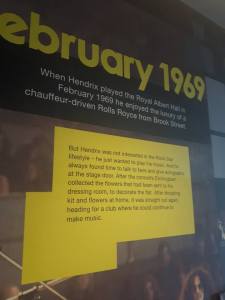
Museums can facilitate biography in their exhibitions, such as this one in Jimi Hendrix’s London flat (Handel & Hendrix). Photo: Serena Ypelaar

Regardless of who you are, you will die having left some indelible mark on the world, no matter how small. Biography is a means of harnessing what we can control about life and preserving it for the future. It doesn’t just document birth, life milestones, education, work, marriage, family, and death. Biography also captures the emotional experience of a person during their life. It gets to the heart of who they were and how they interacted with others.

We can study the lives of the living as well – there are plenty of biographies written about those who are still with us. The bottom line is that biographies outlive us if they’re preserved in the public eye – they can be immortal.

I won’t even wonder whether biography is important: it is. We can’t hope to learn from those who have lived before us, or in some cases alongside us, unless we keep their lessons accessible for future reference.

12yrs
The film “12 Years A Slave” (2013) illustrates the life of Solomon Northup based on his written memoir of his enslavement in America. Photo: Flickr

That said, biography is still an act of interpretation. Even autobiography, the act of telling one’s own life story, consists of interpreting one’s own life and defining it. We must consider the issues that come with biographers as individuals, as their own interpretations can influence the way an individual’s life story is retold.

I think it’s fair to say that we all have some kind of role model (or in my case, many), some of whom we may not have met in person. We venerate them because they made a contribution to public life that would have us remember them. It’s worth questioning what merits a full-scale biography, whether in book form, biopic, documentary, or otherwise. Something in our ability to connect to individuals lends itself to widespread commemoration through biography. But these forms of media aren’t the only kind of biography – for instance, we write our own bios all the time for professional purposes. Biography is an engine of self-definition, a tool of categorization; it’s also a means of trying to understanding each other.

In this column, “On Biography“, we’ll take a look at why we remember certain individuals, how they are remembered, who remembers them, and how this affects their identity, both during their lifetime and after it. We’ll examine what it means to be a person and how public memory can rearrange the collective understanding of people’s lives. And, perhaps most importantly, we’ll learn how people make connections.

annefrank
The diary of Anne Frank, a young Jewish girl who lived in hiding during WWII, is a moving document that has informed countless biographies. What’s so compelling is the diary’s ability to connect us with Anne Frank and her experiences; in reading it, we can hear her speak. Photo: Wikimedia Commons

A biography saves that which we never thought we could save. While it’s not the literal act of saving a life, creating a biography ensures that we can connect to people long after they are gone, whether to learn something or merely to take comfort.

How do we save a life using the limited means afforded to us? Preserve it, and make sure we never forget.